


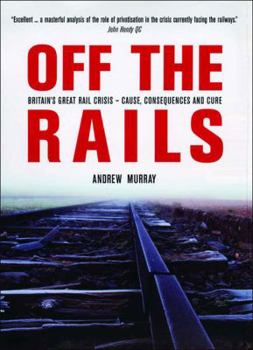
Off the Rails: The Crisis on Britain's Railways

Britain's rail network ground to a halt in the months following the fatal Hatfield crash in October 2000. Widespread speed reductions on potentially unsafe track caused the system-wide delays and... This description may be from another edition of this product.
Format:Hardcover
Language:English
ISBN:1859846408
ISBN13:9781859846407
Release Date:October 2001
Publisher:Verso
Length:240 Pages
Weight:0.75 lbs.
Dimensions:0.8" x 0.1" x 0.6"
Customer Reviews
1 rating
Brilliant attack on privatisation disaster
Published by Thriftbooks.com User , 24 years ago
This excellent book explains why the Major Government privatised rail, privatisation’s effects, and what we should do about it. Privatisation cost the country £6 billion. We gave Railtrack £1000 million a year, £350 million of which it gave to its shareholders. It collapsed last October owing £1.8 billion to subcontractors and £700 million in bills and interest payments to bondholders and banks. The directors of the rail firms prioritised their shareholders’ interests over trivia like safety and public service. They cut costs by sacking maintenance workers – there were 31,000 in 1994, only 19,000 in 2000. Rolling stock, track and signalling equipment are all in a far worse state than under investment-starved British Rail. One caveat: Murray claims that the EU had nothing to do with the privatisation. But EU Regulation EC91/440 ordered that management and financing of track and train services be separate, run on strictly commercial lines and be totally independent of the state. The Commission wants to open up all public services likewise. (See its report COM (2000) 580, ‘Services of a General Interest’.)This government, like its predecessor, opposes introducing the best Automatic Train Protection system, first recommended in 1988, because it would cost too much. We have the world’s highest standard rail fares: fares on the London-Manchester route – a Virgin Trains monopoly –have risen by 50% since 2000. Tested in practice, privatisation has failed to produce a safer, more reliable and more punctual service. The government’s response? Introduce the same failed system into London Underground, education and the National Health Service. Don’t Labour’s focus groups ever include any of the 76% of us who want rail renationalised? Or the 89% who oppose handing public services over to private firms? Why doesn’t the government just renationalise rail? Because it is not democratic: it is totally beholden to private finance. Under PFI, sorry, PPP, firms would be borrowing the money: why not let the public sector do that itself? And we could build the trains and rolling stock we need at Derby, York and Birmingham. We want a publicly run, democratically accountable, integrated railway, instead of the 100-piece, privatised anarchy we now endure.
Copyright © 2026 Thriftbooks.com Terms of Use
| Privacy Policy | Do Not
Sell/Share My Personal Information | Cookie Policy | Cookie Preferences | Accessibility Statement
ThriftBooks® and the ThriftBooks® logo are registered trademarks of Thrift Books Global, LLC
ThriftBooks® and the ThriftBooks® logo are registered trademarks of Thrift Books Global, LLC
