


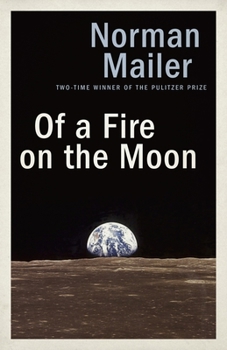
Of a Fire on the Moon

Select Format
Select Condition 
Book Overview
For many, the moon landing was the defining event of the twentieth century. So it seems only fitting that Norman Mailer--the literary provocateur who altered the landscape of American nonfiction--wrote the most wide-ranging, far-seeing chronicle of the Apollo 11 mission. A classic chronicle of America's reach for greatness in the midst of the Cold War, Of a Fire on the Moon compiles the reportage Mailer published between 1969 and 1970 in Life magazine: gripping firsthand dispatches from inside NASA's clandestine operations in Houston and Cape Kennedy; technical insights into the magnitude of their awe-inspiring feat; and prescient meditations that place the event in human context as only Mailer could. Praise for Of a Fire on the Moon "The gift of a genius . . . a twentieth-century American epic--a Moby Dick of space." -- New York "Mailer's account of Apollo 11 stands as a stunning image of human energy and purposefulness. . . . It is an act of revelation--the only verbal deed to be worthy of the dream and the reality it celebrates." -- Saturday Review "A wild and dazzling book." -- The New York Times Book Review "Still the most challenging and stimulating account of the] mission to appear in print." -- The Washington Post Praise for Norman Mailer " Norman Mailer] loomed over American letters longer and larger than any other writer of his generation." -- The New York Times "A writer of the greatest and most reckless talent." -- The New Yorker "Mailer is indispensable, an American treasure." -- The Washington Post "A devastatingly alive and original creative mind." -- Life "Mailer is fierce, courageous, and reckless and nearly everything he writes has sections of headlong brilliance." -- The New York Review of Books "The largest mind and imagination in modern] American literature . . . Unlike just about every American writer since Henry James, Mailer has managed to grow and become richer in wisdom with each new book." -- Chicago Tribune "Mailer is a master of his craft. His language carries you through the story like a leaf on a stream." -- The Cincinnati Post
Format:Paperback
Language:English
ISBN:0553390619
ISBN13:9780553390612
Release Date:June 2014
Publisher:Random House Trade
Length:480 Pages
Weight:0.84 lbs.
Dimensions:1.2" x 5.1" x 7.9"
Customer Reviews
5 ratings
The best Apollo book...
Published by Thriftbooks.com User , 22 years ago
If you read one book about the Apollo moon landings....this is the one. Any other account is superficial in comparison. The author gives concise technical details of the equipment and procedures of the flight. He also explores the motivation and "psychology" of the astronauts without going gaga over their celebrity. Some funny parts are when he describes the frustration of standing in line for an hour for one soda machine (in a forest of spicy food vending machines, unused). He says 3 men at a ballpark concession stand could service the line in a few minutes. From there he has a dialog of how machines are not the answer to everything.Another related episode is describing how the NASA engineers prefer to eat alone in their cubicles without interfacing with other humans because they are preoccupied with their technical problems...very accurate.He compares the specialists of Mission Control to a professor having at his disposal a room of exports on English writers, poets, etc. There are other humorous examples in the book.Toward the end of the book he weighs in with a history of how computers work, this at a time when most people's exposure to a computer was a card that said "don't fold, staple or mutilate" in their utility bill. His technical description of computers is very well done, and this is the only book on the subject that gives an accurate enough description of the computers in use at Houston and on the spacecraft that allows you to directly compare them to what we have today in a home computer. (32k of memory, for instance, on the spacecraft computers).His technical accounts of the moon voyage are accurate and cover interesting detail I do not see by other writers; maybe if you dig into enough NASA documents you might find them. He puts a human face on the whole achievment and gives his opinion of what it all means. I think he was less impressed about it than I was, but this book is the best.
Enjoyable writing about one of the 20th century's biggies
Published by Thriftbooks.com User , 26 years ago
I'm a engineer and I like the way Mailer wrote about the great accomplishments of the project. He pointed out that even looking at a simple gage, there was no way to know how much effort of how many people might have gone into making that instrument. Also, he captured the obsession of many of the engineers with their jobs, and their subsequent high divorce rates.He compared the launch to the scene in Revelation when the last trumpets blow, and I'm sure it must have seemed something like that at the time and place.Good book. You'd think it would be back out in time for the 30th anniversary.
of a fire on the page
Published by Thriftbooks.com User , 27 years ago
Mailer's question: what is the fate, the possibility, the situation of man's noblest capacities in the era of high technology? The answers are, by turns, depressing, funny, rich and profound, vapid, stunning. In the end Mailer leaves us stirred before perhaps the biggest enigma of our time. A really great book that gets dog-eared as you carry it around with you and pore over it.
At times it is inexpressibly breathtaking
Published by Thriftbooks.com User , 28 years ago
I did not read this book until a few years ago but I did witness the events and the moon landing itself on TV as a child. The simplest way for me to express my feelings about this book are try to imagine witnessing a great event and being unable to put it into words. When Mailer describes the take off and the climactic events preceding the landing on the moon it is awe inspiring and I guarantee your pulse will quicken. If you are like me and still fascinated by space and that period of space exploration I urge you to read it.
Mailer, you're on the moon.
Published by Thriftbooks.com User , 28 years ago
Brilliant. What we have here is a seriously under-rated piece of journalism that is truly invigorating. Mailer starts the reader off with a blast to the scene of the pre-take off period of about a month. The reader can feel the excitement of a nation on the verge of curious ecstasy, in an era that is no stranger to curiosity. One can feel the sweat of a hundred tired reporters, can hear the blast of the takeoff...can feel the heat off of the engines. In addition to his knack for describing human characteristics (as he does with Aldrin, Armstrong and Collins), he doesn't shy away from showing us how the innards of the 'beast' work...I'd venture to say that he's as good as Hawking, Feynman or Krauss at explaining science to the 'lay' person. (I can't believe I uttered Krauss in the same breath as Hawking...). His work is laced with 'musings' of his own, but THIS IS NEEDED! It would be dull if we couldn't read Mailer's attempts to show us that Apollo 11 was politically and sociologically significant in so many ways...now how can you resist a good parallel to capitalism? Astounding...it ought to be reprinted...
Copyright © 2026 Thriftbooks.com Terms of Use
| Privacy Policy | Do Not
Sell/Share My Personal Information | Cookie Policy | Cookie Preferences | Accessibility Statement
ThriftBooks® and the ThriftBooks® logo are registered trademarks of Thrift Books Global, LLC
ThriftBooks® and the ThriftBooks® logo are registered trademarks of Thrift Books Global, LLC
