


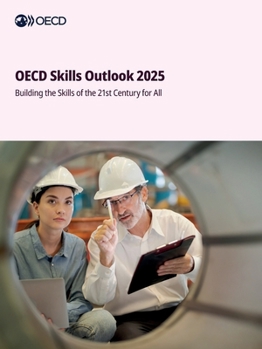
OECD Skills Outlook 2025
No Customer Reviews

The first quarter of the 21st century has been defined by shocks and long-run transformations that have reshaped economic and social systems. These changes have been rapid, leaving less time for individuals, firms and governments to adapt, creating uncertainty. The gaps in who can build, deploy and benefit from essential 21st-century skills, and who is left behind, have been exposed and often widened. Unequal access to skills development impacts not just individuals but also economic growth, which is stunted due to underutilised talent. Disparities in labour market outcomes are varied: those related to socio-economic background arise mainly in the opportunities to develop skills, whereas differences between men and women lie more in how skills are used and rewarded through field-of-study sorting and occupational concentration. Place and immigrant background matter largely via differences in family resources. Returns to skills are large; however, the central challenge for policies is to ensure equal access to the opportunities to develop skills and have them recognised and valued in the labour market. As skills demands evolve faster than traditional policy cycles, targeted investments in lifelong learning and agile, data-driven governance that learns from labour-market intelligence can ease constraints and promote sustained growth.
Format:Paperback
Language:English
ISBN:9264929770
ISBN13:9789264929777
Release Date:December 2025
Publisher:OECD
Length:262 Pages
Weight:1.31 lbs.
Dimensions:0.6" x 8.3" x 11.0"
Customer Reviews
0 rating
Copyright © 2026 Thriftbooks.com
Terms of Use | Privacy Policy | Do Not Sell/Share My Personal Information | Cookie Policy | Cookie Preferences | Accessibility Statement
ThriftBooks ® and the ThriftBooks ® logo are registered trademarks of Thrift Books Global, LLC
ThriftBooks ® and the ThriftBooks ® logo are registered trademarks of Thrift Books Global, LLC
