


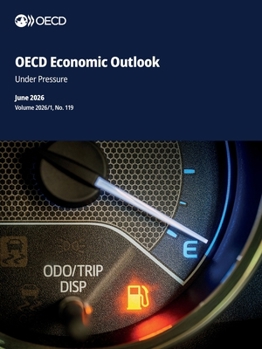
OECD Economic Outlook, Volume 2026 Issue 1
No Customer Reviews

The evolving conflict in the Middle East is having significant humanitarian costs and testing the resilience of a global economy boosted by with solid underlying strong AI-related activity. The prices of energy and other key inputs produced in the Persian Gulf have soared since February, pushing up headline inflation, and some signs of supply shortfalls are emerging amidst disruptions to production and exports. Given the exceptionally uncertain situation this Economic Outlook presents two distinct scenarios of how the global economy could evolve over the next eighteen months. A time-limited disruption scenario, with energy production in the Gulf economies recovering from the third quarter of 2026 would result in global growth moderating in 2026 before picking up in 2027. A prolonged disruption scenario, with supply constraints persisting until the latter half of 2027, would result in significantly weaker growth outcomes and substantially higher inflation in both 2026 and 2027. The slowdown could be exacerbated if AI investment is adversely impacted by disruptions to the supply of energy and other key products or if national export restrictions are introduced. Amidst heightened uncertainty, flexible and agile public policies are needed to ensure macroeconomic stability. Key medium-term policy priorities also remain, such as the need to establish a credible fiscal path to debt sustainability, enhance energy security and resilience, secure a lasting decline in trade tensions and strengthen the prospects for sustainable and resilient growth.
Format:Paperback
Language:English
ISBN:9264462961
ISBN13:9789264462960
Release Date:June 2026
Publisher:OECD
Length:298 Pages
Weight:1.49 lbs.
Dimensions:0.6" x 8.3" x 11.0"
Customer Reviews
0 rating
Copyright © 2026 Thriftbooks.com
Terms of Use | Privacy Policy | Do Not Sell/Share My Personal Information | Cookie Notice | Cookie Preferences | Accessibility Statement
ThriftBooks ® and the ThriftBooks ® logo are registered trademarks of Thrift Books Global, LLC
ThriftBooks ® and the ThriftBooks ® logo are registered trademarks of Thrift Books Global, LLC
