


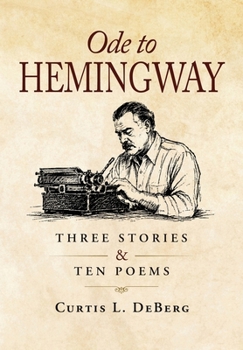
Ode to Hemingway: Three Stories & Ten Poems

Ode to Hemingway is a literary hybrid that blends fiction, memoir, and poetry into a single narrative of endurance, recovery, and reflection. In the spirit of Hemingway's Three Stories and Ten Poems, it uses a spare, disciplined structure to hold together the broken and overlapping experiences of a life changed by catastrophe. The result is a book shaped by compression and restraint, where what is omitted carries as much weight as what is said. That approach aligns with Hemingway's own emphasis on terse, economical prose and the idea that style can function as a moral act, revealing truth through simplicity and precision.
At its center is the aftermath of a devastating plane crash, but the book reaches beyond the crash itself to examine the longer, less visible recoveries that follow trauma: the body's slow return, the mind's dislocation, and the way ordinary time is altered by disaster. The pandemic years deepen that sense of estrangement, making isolation, uncertainty, and interruption part of the book's emotional landscape. Rather than presenting recovery as a straight line, the work treats it as uneven, recursive, and shaped by endurance more than resolution. This emphasis on resilience and emotional exactness is consistent with Hemingway's broader literary legacy, which often places characters in conditions of crisis and asks how they live with loss, pain, and mortality.
In Part I, the three stories dramatize moments when ordinary life tips into moral or emotional emergency. A lineman in West Texas faces an impossible medical decision; a professor in the Midwest confronts a student's escalating desperation; and a man in Pamplona moves through pain, memory, and self-destruction. Each story is grounded in realism, but each also reveals the hidden pressure beneath the surface of daily life. Together, they explore resilience, grief, and the search for moral clarity in situations where no clean answer exists. The stories' quiet intensity recalls Hemingway's short fiction, where crucial emotional events are often conveyed indirectly, through action, omission, and implication rather than explanation.
The Interlude shifts the book into a more reflective register, turning from narrative events to questions of taste, criticism, and value. Its focus on private "utility functions" suggests that literature and life are both shaped by the different ways people assign meaning to experience, art, and memory. This gives the book an essayistic dimension: it is not only telling stories, but also asking why certain stories matter and how individuals decide what is worth keeping, revisiting, or believing. In that sense, Ode to Hemingway becomes both an homage to Hemingway's stripped-down form and a meditation on the personal logic by which people build meaning out of rupture.
Customer Reviews
ThriftBooks ® and the ThriftBooks ® logo are registered trademarks of Thrift Books Global, LLC
