


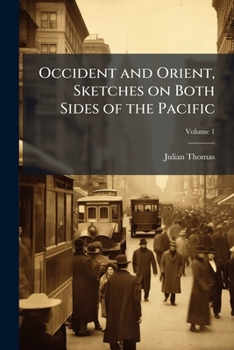
Occident and Orient, Sketches on Both Sides of the Pacific; Volume 1

"Occident and Orient, Sketches on Both Sides of the Pacific, Volume 1" offers a captivating glimpse into the late 19th-century world through the eyes of Julian Thomas. This volume presents a collection of observations and reflections gathered during his travels across the Pacific, contrasting the cultures and landscapes of the West with those of the East.
Thomas's keen eye for detail and engaging narrative style bring to life the people, customs, and environments he encounters. From bustling cityscapes to serene natural wonders, his sketches provide a vivid portrait of a world undergoing rapid change. Readers will find themselves transported to distant lands, gaining insights into the diverse societies and traditions that shaped the era.
This historical travelogue offers valuable perspectives on cross-cultural interactions and the evolving relationship between Occident and Orient, making it a compelling read for anyone interested in travel history, cultural studies, and the exploration of the Pacific region.
This work has been selected by scholars as being culturally important, and is part of the knowledge base of civilization as we know it. This work was reproduced from the original artifact, and remains as true to the original work as possible. Therefore, you will see the original copyright references, library stamps (as most of these works have been housed in our most important libraries around the world), and other notations in the work.
This work is in the public domain in the United States of America, and possibly other nations. Within the United States, you may freely copy and distribute this work, as no entity (individual or corporate) has a copyright on the body of the work.
As a reproduction of a historical artifact, this work may contain missing or blurred pages, poor pictures, errant marks, etc. Scholars believe, and we concur, that this work is important enough to be preserved, reproduced, and made generally available to the public. We appreciate your support of the preservation process, and thank you for being an important part of keeping this knowledge alive and relevant.
Customer Reviews
ThriftBooks® and the ThriftBooks® logo are registered trademarks of Thrift Books Global, LLC
