


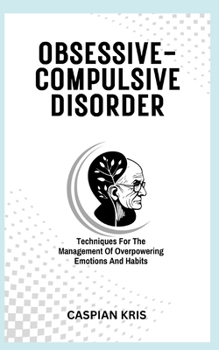
Obsessive-Compulsive Disorder: Techniques For The Management Of Overpowering Emotions And Habits
No Customer Reviews

Recurrent, painful, and unwelcome ideas, impulses, or mental images are what we mean when we talk about obsessions. It's impossible to stop thinking these things, and they're really distressing. Obsessions are common, and they can range from uncomfortable religious or sexual fantasies to irrational concerns of germs or injuring oneself or others.
Repetitive actions or thoughts that a person feels compelled to perform because of their obsessions are called compulsions. Compulsions are an attempt to alleviate the suffering brought on by obsessions, but they are frequently extreme and have no rational relationship to the feared consequence. A person with a fear of germs may, for no good reason, wash their hands repeatedly for an extended amount of time.
An individual's day-to-day activities, relationships, and productivity may all be negatively impacted by the time spent dealing with OCD. It can be difficult for people with OCD to manage or fight their obsessions and compulsions, despite the fact that they are aware of their irrationality.
Being specific, organized, or faultless are not the same thing as having obsessive compulsive disorder (OCD). It's a difficult mental illness to diagnose, and its root causes are murky at best. But its emergence could be influenced by things like genetics, brain anatomy/function, and the environment.
Some people with OCD also benefit from medication, such as selective serotonin reuptake inhibitors (SSRIs), in addition to cognitive-behavioral treatment (CBT) methods like exposure and response prevention (ERP). You or someone you care about should consult a mental health professional for an accurate diagnosis and effective treatment of obsessive-compulsive disorder (OCD) symptoms.
Repetitive actions or thoughts that a person feels compelled to perform because of their obsessions are called compulsions. Compulsions are an attempt to alleviate the suffering brought on by obsessions, but they are frequently extreme and have no rational relationship to the feared consequence. A person with a fear of germs may, for no good reason, wash their hands repeatedly for an extended amount of time.
An individual's day-to-day activities, relationships, and productivity may all be negatively impacted by the time spent dealing with OCD. It can be difficult for people with OCD to manage or fight their obsessions and compulsions, despite the fact that they are aware of their irrationality.
Being specific, organized, or faultless are not the same thing as having obsessive compulsive disorder (OCD). It's a difficult mental illness to diagnose, and its root causes are murky at best. But its emergence could be influenced by things like genetics, brain anatomy/function, and the environment.
Some people with OCD also benefit from medication, such as selective serotonin reuptake inhibitors (SSRIs), in addition to cognitive-behavioral treatment (CBT) methods like exposure and response prevention (ERP). You or someone you care about should consult a mental health professional for an accurate diagnosis and effective treatment of obsessive-compulsive disorder (OCD) symptoms.
Format:Paperback
Language:English
ISBN:B0CGWYMVXD
ISBN13:9798859283736
Release Date:August 2023
Publisher:Independently Published
Length:78 Pages
Weight:0.19 lbs.
Dimensions:0.2" x 5.0" x 8.0"
Customer Reviews
0 rating
Copyright © 2026 Thriftbooks.com Terms of Use
| Privacy Policy | Do Not
Sell/Share My Personal Information | Cookie Policy | Cookie Preferences | Accessibility Statement
ThriftBooks® and the ThriftBooks® logo are registered trademarks of Thrift Books Global, LLC
ThriftBooks® and the ThriftBooks® logo are registered trademarks of Thrift Books Global, LLC
