


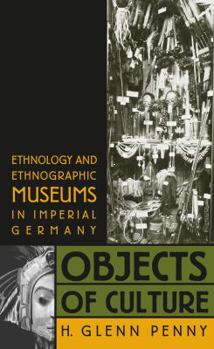
Objects of Culture: Ethnology and Ethnographic Museums in Imperial Germany

Select Format
Select Condition 
Book Overview
In the late nineteenth century, Germans spearheaded a worldwide effort to preserve the material traces of humanity, designing major ethnographic museums and building extensive networks of communication and exchange across the globe. In this groundbreaking study, Glenn Penny explores the appeal of ethnology in Imperial Germany and analyzes the motivations of the scientists who created the ethnographic museums.
Penny shows that German ethnologists were not driven by imperialist desires or an interest in legitimating putative biological or racial hierarchies. Overwhelmingly antiracist, they aspired to generate theories about the essential nature of human beings through their museums' collections. They gained support in their efforts from boosters who were enticed by participating in this international science and who used it to promote the cosmopolitan character of their cities and themselves. But these cosmopolitan ideals were eventually overshadowed by the scientists' more modern, professional, and materialist concerns, which dramatically altered the science and its goals.
By clarifying German ethnologists' aspirations and focusing on the market and conflicting interest groups, Penny makes important contributions to German history, the history of science, and museum studies.
Penny shows that German ethnologists were not driven by imperialist desires or an interest in legitimating putative biological or racial hierarchies. Overwhelmingly antiracist, they aspired to generate theories about the essential nature of human beings through their museums' collections. They gained support in their efforts from boosters who were enticed by participating in this international science and who used it to promote the cosmopolitan character of their cities and themselves. But these cosmopolitan ideals were eventually overshadowed by the scientists' more modern, professional, and materialist concerns, which dramatically altered the science and its goals.
By clarifying German ethnologists' aspirations and focusing on the market and conflicting interest groups, Penny makes important contributions to German history, the history of science, and museum studies.
Format:Paperback
Language:English
ISBN:0807854301
ISBN13:9780807854303
Release Date:December 2002
Publisher:University of North Carolina Press
Length:304 Pages
Weight:0.05 lbs.
Dimensions:0.7" x 6.3" x 8.7"
Customer Reviews
1 rating
History of the Development of German Ethnographic Museums
Published by Thriftbooks.com User , 17 years ago
This book, based on the author's doctoral thesis, is an excellent exploration of the development of ethnographic museums in Germany. These museums originally evolved from scattered ethnographic collections. They were developed and funded as a result of competition between different municipal governments. Originally the stated purpose of such institutions was to understand man kind by collecting exhaustive examples of material culture from "disappearing" societies with a view to understanding them through evaluating these materials. Later there was more of a focus on the public nature of museums and how certain types of displays could make human variation more accessible to the public. One major change was from typological arrangements to geographically oriented arrangements. Display cases went from being packed with examples of spears from a variety of cultures to thoughtful arrangements of objects from a single culture. He discusses problems such as lack of space, need for more labels and the focus on accumulating more and more objects at the expense of cataloging or evaluating them. He gives numerous interesting examples of political strife and also how collecting was carried out in the field in the colonial context including a descriptions of some less than ethical collectors. Overall, for someone who is interested in this topic, this is an excellent book which held my interest throughout.
Copyright © 2026 Thriftbooks.com Terms of Use
| Privacy Policy | Do Not
Sell/Share My Personal Information | Cookie Policy | Cookie Preferences | Accessibility Statement
ThriftBooks® and the ThriftBooks® logo are registered trademarks of Thrift Books Global, LLC
ThriftBooks® and the ThriftBooks® logo are registered trademarks of Thrift Books Global, LLC
