


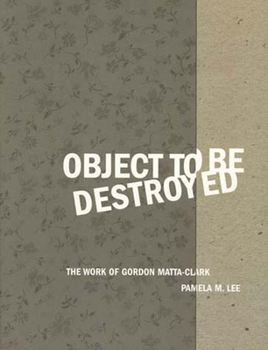
Object to Be Destroyed

Select Format
Select Condition 
Book Overview
In this first critical account of Matta-Clark's work, Pamela M. Lee considers it in the context of the art of the 1970s--particularly site-specific, conceptual, and minimalist practices--and its confrontation with issues of community, property, the alienation of urban space, the "right to the city," and the ideologies of progress that have defined modern building programs.
Although highly regarded during his short life--and honored by artists and architects today--the American artist Gordon Matta-Clark (1943-78) has been largely ignored within the history of art. Matta-Clark is best remembered for site-specific projects known as "building cuts." Sculptural transformations of architecture produced through direct cuts into buildings scheduled for demolition, these works now exist only as sculptural fragments, photographs, and film and video documentations. Matta-Clark is also remembered as a catalytic force in the creation of SoHo in the early 1970s. Through loft activities, site projects at the exhibition space 112 Greene Street, and his work at the restaurant Food, he participated in the production of a new social and artistic space.
Have art historians written so little about Matta-Clark's work because of its ephemerality, or, as Pamela M. Lee argues, because of its historiographic, political, and social dimensions? What did the activity of carving up a building-in anticipation of its destruction--suggest about the conditions of art making, architecture, and urbanism in the 1970s? What was one to make of the paradox attendant on its making--that the production of the object was contingent upon its ruination? How do these projects address the very writing of history, a history that imagines itself building toward an ideal work in the service of progress?
In this first critical account of Matta-Clark's work, Lee considers it in the context of the art of the 1970s--particularly site-specific, conceptual, and minimalist practices--and its confrontation with issues of community, property, the alienation of urban space, the "right to the city," and the ideologies of progress that have defined modern building programs.
Customer Reviews
ThriftBooks ® and the ThriftBooks ® logo are registered trademarks of Thrift Books Global, LLC
