


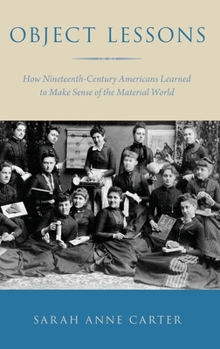
Object Lessons: How Nineteenth-Century Americans Learned to Make Sense of the Material World
No Customer Reviews

Object Lessons: How Nineteenth-Century Americans Learned to Make Sense of the Material World examines the ways material things--objects and pictures--were used to reason about issues of morality, race, citizenship, and capitalism, as well as reality and representation, in the nineteenth-century United States. For modern scholars, an "object lesson" is simply a timeworn metaphor used to describe any sort of reasoning from concrete to abstract. But in the 1860s, object lessons were classroom exercises popular across the country. Object lessons helped children to learn about the world through their senses--touching and seeing rather than memorizing and repeating--leading to new modes of classifying and comprehending material evidence drawn from the close study of objects, pictures, and even people. In this book, Sarah Carter argues that object lessons taught Americans how to find and comprehend the information in things--from a type-metal fragment to a whalebone sample. Featuring over fifty images and a full-color insert, this book offers the object lesson as a new tool for contemporary scholars to interpret the meanings of nineteenth-century material, cultural, and intellectual life.
Format:Hardcover
Language:English
ISBN:0190225033
ISBN13:9780190225032
Release Date:August 2018
Publisher:Oxford University Press, USA
Length:218 Pages
Weight:0.95 lbs.
Dimensions:0.9" x 6.1" x 9.3"
Customer Reviews
0 rating
Copyright © 2026 Thriftbooks.com Terms of Use
| Privacy Policy | Do Not
Sell/Share My Personal Information | Cookie Policy | Cookie Preferences | Accessibility Statement
ThriftBooks® and the ThriftBooks® logo are registered trademarks of Thrift Books Global, LLC
ThriftBooks® and the ThriftBooks® logo are registered trademarks of Thrift Books Global, LLC
