


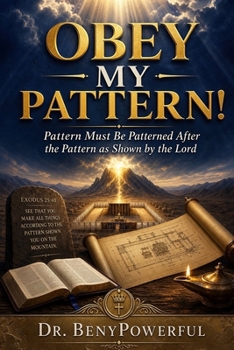
OBEY THE PATTERN!

What is a pattern? It is the form of the unseen made visible. It is the heaven on the mountain made the earth in the valley. It is the eternal counsel of God translated into the language of cedar and gold and shewbread and blood. The pattern is not a suggestion. The pattern is not an outline. The pattern is the very mind of God in measurable form.
Hear the word of the Lord to Moses: According to all that I shew thee, after the pattern of the tabernacle, and the pattern of all the instruments thereof, even so shall ye make it (Exodus 25:9). And again: And look that thou make them after their pattern, which was shewed thee in the mount (Exodus 25:40). The Hebrew word is tavn t - תַּבְנִית - meaning structure, model, blueprint, the very form of a thing as it exists in the eternal mind before it ever appears in time. In the Aramaic of the Peshitta the corresponding word is dm t - ܕܡܘܬܐ - likeness, image, the visible echo of an invisible original. In the Greek of the Septuagint and the New Testament the word is tupos - τύπος - the impression left by a seal, the mark struck by a hammer, the form pressed into wax that proves the wax was once shaped by a will outside itself.
The pattern, then, is the seal of God upon the creation. And the creation is meant to bear the seal. When the seal is broken, the creation groans. When the seal is restored, the creation is delivered.
Why did God give a pattern? Because heaven cannot be improvised. The throne is not a suggestion. The cherubim are not symbolic decoration. The mercy seat is not a stylistic choice. Every dimension of the tabernacle was a dimension of the heavenly reality, and Moses was commanded to copy heaven, not to invent earth. Hebrews 8:5 makes the matter plain: Who serve unto the example and shadow of heavenly things, as Moses was admonished of God when he was about to make the tabernacle: for, See, saith he, that thou make all things according to the pattern shewed to thee in the mount. Hupodeigma is the Greek - ὑπόδειγμα - copy, replica, the visible image of an invisible architecture.
If Moses had improvised, the tabernacle would have been beautiful and powerless. If Moses had innovated, the cloud would not have descended. If Moses had decorated according to his own taste, the glory would have refused the building. The pattern was not artistic. The pattern was covenantal. The pattern was the condition under which the glory consented to dwell.
So it is in this generation. The reason the glory has not descended on seventy-two thousand denominations is that seventy-two thousand denominations have not built according to the pattern. They have built according to opinion. They have built according to inheritance. They have built according to the spirit of the age. And the cloud waits.
Customer Reviews
ThriftBooks ® and the ThriftBooks ® logo are registered trademarks of Thrift Books Global, LLC
