


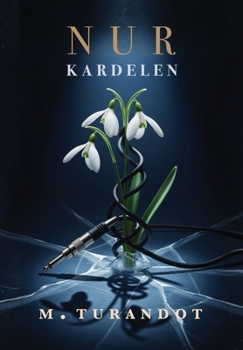
Nur Kardelen

Ann Arbor, January 1994. Nur Kardelen is the perfect daughter of a Turkish surgeon: doctoral candidate in atmospheric science, obedient at dinner, flawless at the piano. She is also the builder of a secret. The White Lion, fourteen pounds of instrument she has carried for twelve years, turns weather into music: pressure fronts into chords, humidity into color, the sky's raw data into song. No one has ever heard it.
Then, at two in the morning, a trumpet answers through a practice-room wall.
Eliano Valenti, mathematician, heir to four centuries of Genoese shipping, a man who chose frequencies over freighters, has been searching for exactly this signal without knowing it had a name. Around the two of them, a band assembles: a drummer from Hamtramck, a bassist from ten generations of Vermont stone, and a saxophonist from East L.A. When an IRCAM residency calls them to Paris, Nur steps out of her father's glass house and into the open air, and the music begins to travel: a jazz cellar on the Rue des Lombards, a rooftop above the Bosphorus, a pier on the Pacific.
But the signal leads somewhere she has spent nineteen years not looking. In Istanbul waits the mother who vanished when Nur was seven, leaving behind postcards turned facedown and a sentence stopped mid-word. And in Los Angeles waits a contract that offers Nur the world, in exchange for the one thing she has only just learned to keep.
Kardelen is Turkish for snowdrop: literally, the one that pierces the snow, the flower that blooms through ice because nobody told it that it couldn't. In the tradition of the great artist's-coming-of-age novels, Nur Kardelen is a story about inheritance and improvisation, mothers and daughters, the instruments we build to say what we cannot, and the discovery that the signal was never in the source. Told in five movements, with the complete lyrics to the novel's eleven original songs.
Some notes are heard. Some are felt. Some remember us.
Customer Reviews
ThriftBooks ® and the ThriftBooks ® logo are registered trademarks of Thrift Books Global, LLC
