


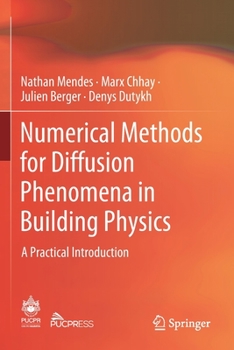
Numerical Methods for Diffusion Phenomena in Building Physics: A Practical Introduction

Select Format
Select Condition 
Book Overview
A brief history of diffusion in physics
Part I Basics of numerical methods for diffusion phenomena in building physics
2. Heat and Mass Diffusion in Porous Building Elements
2.1 A brief historical
2.2 Heat and mass diffusion models
2.3 Boundary conditions
2.4 Discretization
2.5 Stability conditions2.6 Linearization of boundary conditions or source terms
2.7 Numerical algorithms
2.8 Multitridiagonal-matrix algorithm2.9 Mathematical model for a room air domain
2.10 Hygrothermal models used in some available simulation tools
2.11 Final remarks
3. Finite-Difference Method
3.1 Numerical methods for time evolution: ODE
3.1.1 An introductory example
3.1.2 Generalization
3.1.3 Systems of ODEs3.1.4 Exercises
3.2 Parabolic PDE
3.2.1 The heat equation in 1D3.2.2 Nonlinear case
3.2.3 Applications in engineering
3.2.4 Heat equation in two and three space dimensions3.2.5 Exercises
4. Basics in Practical Finite-Element Method
4.1 Heat Equation
4.1.1 Weak formulation and test functions4.1.2 Finite element representation
4.1.3 Finite element approximation
4.2 Finite element approach revisited4.2.1 Reference element
4.2.2 Connectivity table
4.2.3 Stiffness matrix construction4.2.4 Final remarks
Part II Advanced numerical methods
5 Explicit schemes with improved CFL condition
5.0.1 Some healthy criticism
5.1 Classical numerical schemes
5.1.1 The Explicit scheme
5.1.2 The Implicit scheme
5.1.3 The Leap-frog scheme5.1.4 The Crank-Nicholson scheme
5.1.5 Information propagation speed
5.2 Improved explicit schemes5.2.1 Dufort-Frankel method
5.2.2 Saulyev method
5.2.3 Hyperbolization method5.3 Discussion
6 Reduced Order Methods
6.1 Introduction
6.1.1 Physical problem and Large Original Model
6.1.2 Model reduction methods for Building physics application
6.2 Balanced truncation
6.2.1 Formulation of the ROM
6.2.2 Marshall truncation Method6.2.3 Building the ROM
6.2.4 Synthesis of the algorithm
6.2.5 Application and exercise6.2.6 Remarks on the use of balanced truncation
6.3 Modal Identification
6.3.1 Formulation of the ROM6.3.2 Identification process
6.3.3 Synthesis of the algorithm
6.3.4 Application and exercise6.3.5 Some remarks on the use of the MIM
6.4 Proper Orthogonal Decomposition Basics
6.4.2 Capturing the main information6.4.3 Building the POD model
6.4.4 Synthesis of the algorithm
6.4.5 Application and Exercise6.4.6 Remarks on the use of the POD
6.5 Proper Generalized Decomposition
6.5.1 Basics6.5.2 Iterative solution
6.5.3 Computing the modes
6.5.4 Convergence of global enrichment6.5.5 Synthesis of the algorithm
6.5.6 Application and Exercise
6.5.7 Remarks on the use of the PGD6.6 Final remarks
7. Boundary Integral Approaches
7.1 Basic BIEM
7.1.1 Domain and boundary integral expressions
7.1.2 Green function and boundary integral formulation
7.1.3 Numerical formulation
7.2 Trefftz method
7.2.1 Trefftz indirect method7.2.2 Method of fundamental solutions
7.2.3 Trefftz direct method
7.2.4 Final remarks
8. Spectral Methods
8.1 Introduction to spectral methods
8.1.1 Choice of the basis
8.1.2 Determining ex
Customer Reviews
ThriftBooks® and the ThriftBooks® logo are registered trademarks of Thrift Books Global, LLC
