


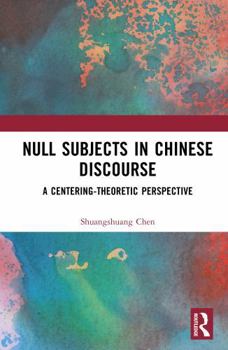
Null Subjects in Chinese Discourse: A Centering-Theoretic Perspective

This book explains how Mandarin Chinese often leaves the subject unspoken and how readers can still work out 'who' or 'what' is being talked about by identifying patterns in connected discourse.
Drawing on a carefully compiled corpus of balanced genres, the book illustrates where missing subjects tend to occur and how their meaning is inferred from context. It provides a clear, practical classification of null subjects and introduces a transparent method for identifying the grammatical and discourse cues that inform interpretation. The book also sets out a step-by-step procedure for resolving missing subjects, based on Centering Theory, and evaluates this procedure using annotated data, thereby bringing together linguistic theory and computational methods. Together, these components offer an accessible account of how reference and coherence are maintained in Chinese when the subject is not overtly expressed.
Evidence-based and clear, this book will be of interest to linguists, students and general readers curious about how language works. It is particularly relevant to the fields of Chinese linguistics, discourse and pragmatics, and language technology.
Customer Reviews
ThriftBooks® and the ThriftBooks® logo are registered trademarks of Thrift Books Global, LLC
