


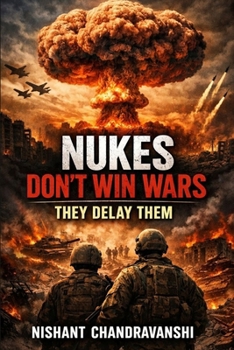
Nukes Don't Win Wars: They Delay Them

Nuclear weapons did not end war.
They changed its shape.
Victory became dangerous.
So conflict learned how to wait.
Wars stopped finishing.
They began lingering.
Violence moved away from battlefields
and into economies, energy systems, and civilian life.
Time replaced force.
Delay replaced decision.
For decades, the absence of World War III has been treated as proof that nuclear weapons work.
But if deterrence created peace, the world would feel stable.
It doesn't.
Instead, conflicts stretch without resolution.
Costs compound quietly.
Instability feels permanent, even when escalation is "contained."
This book explains why.
Not by arguing morality.
Not by assigning blame.
But by examining structure.
When decisive force becomes unusable, pressure does not disappear.
It reroutes.
Into proxy wars.
Into energy and supply chains.
Into finance, insurance, inflation, and time itself.
This book shows how the nuclear age did not remove conflict -
it reformatted it.
You'll learn:
- Why nuclear weapons made victory dangerous, not obsolete
- How deterrence freezes escalation but spreads pressure sideways
- Why modern wars linger instead of ending
- How energy systems and economies became battlefields
- Why delay favors some states and destroys others
- How instability can persist without decisive war
- Why the world feels tense even when "nothing happens"
This is not a book about military tactics.
It is not a book about ideology.
It offers no predictions and no solutions.
That is intentional.
Most damage in modern systems does not come from reckless decisions.
It comes from reasonable ones made under constraint.
Deterrence did not fail loudly.
It succeeded narrowly - and reshaped everything downstream.
This book is written for readers who sense that modern conflict no longer looks like war,
yet never feels like peace.
It does not promise reassurance.
It removes false certainty.
Because delay is not peace.
And understanding how power waits
is more useful than believing it rests.
Customer Reviews
ThriftBooks® and the ThriftBooks® logo are registered trademarks of Thrift Books Global, LLC
