


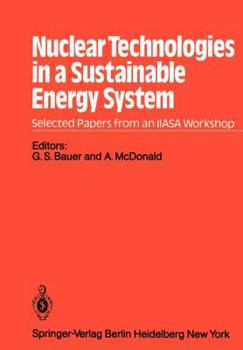
Nuclear Technologies in a Sustainable Energy System
No Customer Reviews

In March 1981 the International Institute for Applied Systems Analysis (IIASA) published the results of a global energy study looking fifty years into the future: Energy in a Finite World: A Global Systems Analysis (Cambridge, Massachusetts: Ballinger Publishing Co., 1981)*. Not surprisingly, this book raises almost as many questions as it answers; thus, it defines a broad range of research topics that might be taken up by IIASA or other research institutions around the world. A 25-27 May 1981 workshop at IIASA entitled "A Perspective on Adaptive Nuclear Energy Evolutions: Towards a World of Neutron Abundance" was a beginning on one of these topics; it was organized by Wolf Hafele (Kernforschungsanlage Ji. ilich, Jiilich, Federal Republic of Germany, and IIASA) and Arkadius Archie Harms (McMaster University, Hamilton, Ontario, Canada). The origin of this workshop was the effort with- in the IIASA energy study to explore possible "sustainable" global energy systems that might eventually replace the current "consumptive" system. In investigating the possible contributions nuclear technologies might make to a sustainable energy system, it had become clear that it is not so much particular, distinct technologies within the nuclear family that should be examined as a question of particularly advantageous configurations of mutually complementary technologies. Only when one considers exploiting a whole spectrum of arrangements of fission breeders, fusion reactors, and accelerators does the true potential of nuclear power become apparent.
Format:Paperback
Language:English
ISBN:3642819907
ISBN13:9783642819902
Release Date:December 2011
Publisher:Springer
Length:330 Pages
Weight:1.19 lbs.
Dimensions:0.7" x 6.7" x 9.6"
Customer Reviews
0 rating
Copyright © 2026 Thriftbooks.com Terms of Use
| Privacy Policy | Do Not
Sell/Share My Personal Information | Cookie Policy | Cookie Preferences | Accessibility Statement
ThriftBooks® and the ThriftBooks® logo are registered trademarks of Thrift Books Global, LLC
ThriftBooks® and the ThriftBooks® logo are registered trademarks of Thrift Books Global, LLC
