


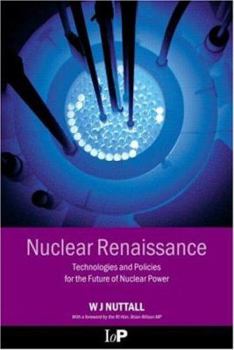
Nuclear Renaissance: Technologies and Policies for the Future of Nuclear Power


With growing concerns over environmental issues and global energy consumption, there is increasing interest in nuclear power generation, despite its diminished role in the West over the last few decades. Many of those involved with nuclear power and environmental agencies see controlled expansion of nuclear plants as the most environmentally friendly way of meeting growing energy demands.
Nuclear Renaissance: Technologies and Policies for the Future of Nuclear Power examines the future of nuclear power in the contexts of economics, environmental sustainability, and security of electricity supplies. A range of future technologies is considered, illustrating the technical challenges and opportunities facing nuclear power. This semi-technical overview of modern technologies meets the growing interest from scientists, environmentalists, and governments in the potential expansion of nuclear power. Various countries are starting to announce plans for new nuclear plants, either to replace those being decommissioned or to provide additional power. Many commentators regard this renaissance as just beginning. Nuclear Renaissance: Technologies and Policies for the Future of Nuclear Power is essential reading for physicists, engineers, policy-makers, researchers, energy analysts and graduate students in energy sciences, engineering and public policy.Format:Hardcover
Language:English
ISBN:0750309369
ISBN13:9780750309363
Release Date:December 2004
Publisher:CRC Press LLC
Length:336 Pages
Weight:1.72 lbs.
Dimensions:9.3" x 1.0" x 6.3"
Customer Reviews
2 ratings
Superb Overview of Nuclear Power as of 2003
Published by Thriftbooks.com User , 20 years ago
This book is slightly marred by a somewhat fuzzy Afterword and reuse of identical language when the same information is repeated in different sections leading to a jarring sense of deja vue for one reading it cover-to-cover (As I did). However it is a wonderful, highly readable, generally excelently observed, world overview/annotated bibliography of nuclear technologies -- providing in one volume valuable perspective, awesome research, and pointers to more definitive treatments for nearly every item discussed.
Essential for any decent library
Published by Thriftbooks.com User , 21 years ago
Every university library in the UK and USA should have a copy of this; and every college teaching any kind of technology and society qualification. Bill is not shy of stating his own opinions, but this never has any detrimental effect on the objectivity of the content. He really does not like the accounting distinction between a waste and an asset; particularly where plutonium is concerned, as this makes no difference to what you would actually do with the stuff. He is quite aware that it makes a big difference to the balance sheet of British Energy, but as he says, since this company was effectively destroyed by low electricity prices, it has to be bailed out by the UK government anyway. The term "actinide management" in the American dominated G-IV report also comes in for some criticism as a pointless euphemism for what eveyone knows is fuel reproessing. Another political issue is that discussions of legacy nuclear waste are separated from discussions of waste from future programmes. Bill ably makes the point that optimising these two issues in isolation is likely to lead to a non-optimal overall programme. The book is salted with intriguing asides: such as that the oil industries are much better at understanding risk and managing multi-decade projects, whereas todays electricity companies have problems imagining the future only one year ahead. Therefore the logical companies to develop fission reactors in the next 40 years are the existing oil and gas companies, not electricity producers. These companies also have the skills to use nuclear heat for chemical processing and not just electricity production. There are additional points made that you would not find (certainly not easily) in any original reports: the issue of training and the availability of experienced nuclear engineers in the UK; the difficulty of finding independent nuclear waste disposal experts who have not at some time had a grant or contract from NIREX to study the issues. The "polluter pays" principle may seem obviously attractive, but Bill shows that it has awkward and counter-productive effects within the particular organisational structures we find ourselves inheriting in the UK. Similarly the "intergenerational equity" principle actually leads to exactly the opposite behaviour from that which one might want. A technology policy point which is better articulated by Bill than anywhere else I have seen is in the view of risk: the public can prefer a techniology which the technical experts regard as not only dangerous, but professionally unethical. The public in many countries prefers risk to be borne by informed volunteers (employees, typically) whereas engineers tend to believe that it is preferable to structure risks so that the overall mininum number of people are affected. Thus many people prefer the option of "partioning and transmuting" fuel wastes to reduce the impact on future generations, even if the extensive new chemical processing required will almost inevi
Copyright © 2026 Thriftbooks.com
Terms of Use | Privacy Policy | Do Not Sell/Share My Personal Information | Cookie Policy | Cookie Preferences | Accessibility Statement
ThriftBooks ® and the ThriftBooks ® logo are registered trademarks of Thrift Books Global, LLC
ThriftBooks ® and the ThriftBooks ® logo are registered trademarks of Thrift Books Global, LLC
