


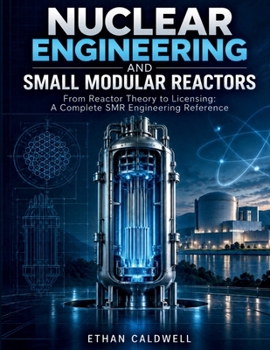
Nuclear Engineering and Small Modular Reactors: From Reactor Theory to Licensing: A Complete SMR Engineering Reference

Small modular reactors are changing the way nuclear power is designed, licensed, constructed, and deployed. But understanding them requires more than knowing the latest reactor concepts-it requires a firm command of the nuclear engineering principles that make those designs possible.
Nuclear Engineering and Small Modular Reactors brings those two worlds together in one comprehensive engineering reference.
Beginning with the fundamentals of nuclear physics, neutron interactions, reactor theory, kinetics, thermal-hydraulics, and heat transfer, the book builds the technical foundation needed to understand how modern reactor systems behave. It then applies that foundation directly to the engineering challenges that define today's small modular reactor landscape.
Across eighteen self-contained chapters, you'll explore:
Nuclear fission, neutron diffusion, criticality, reactor kinetics, and reactivity controlCore thermal-hydraulics, heat transfer, critical heat flux, and thermal design marginsReactor fuels, cladding, structural materials, radiation damage, and coolant chemistryPassive safety systems, natural circulation, defense-in-depth, and simplified SMR architecturesLight-water and non-light-water SMR technologies, including integral PWRs, gas-cooled reactors, molten-salt systems, sodium-cooled reactors, and microreactorsNuclear fuel-cycle engineering, enrichment, HALEU, fuel management, and spent-fuel considerationsDigital instrumentation and control, reactor protection systems, cybersecurity, and common-cause failureDeterministic safety analysis, probabilistic risk assessment, event trees, fault trees, CDF, and LERFRadiation shielding, occupational protection, waste management, and spent-fuel storageU.S. reactor licensing pathways under 10 CFR Parts 50, 52, and the emerging technology-inclusive frameworkSiting, modular manufacturing, construction quality assurance, project economics, financing, grid integration, and deployment strategyThe book is designed for both structured study and day-to-day reference use. Each chapter stands on its own, allowing readers to go directly to the subject they need without relying on material from earlier chapters.
Worked examples follow a consistent step-by-step format, practice problems include worked answers, and engineering quantities are presented in both U.S. customary and SI units. The book also includes a glossary, notation and symbol references, unit-conversion tables, physical constants, standards and regulatory references, and a full index.
Written for practicing nuclear and mechanical engineers, advanced undergraduate and graduate students, licensing and safety professionals, and engineers entering the advanced-reactor field, this book provides a single technical reference spanning the path from reactor theory to real-world SMR engineering and licensing.
For readers who want to understand small modular reactors as complete engineered systems-not simply as emerging technology-this book provides the physics, engineering methods, safety principles, and regulatory context needed to see the full picture.
Customer Reviews
ThriftBooks ® and the ThriftBooks ® logo are registered trademarks of Thrift Books Global, LLC
