


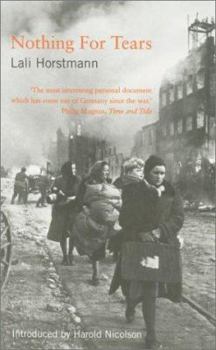
Nothing For Tears


Select Format
Select Condition 
Book Overview
A memoir of Lali Horstmann's time living in Kenya as a young woman in the 1950s, her relationships with local tribes, and the challenges of adapting to a new culture.This work has been selected by... This description may be from another edition of this product.
Format:Paperback
Language:English
ISBN:1842122126
ISBN13:9781842122129
Release Date:June 2001
Publisher:Phoenix
Length:224 Pages
Weight:0.70 lbs.
Dimensions:8.3" x 0.8" x 5.3"
Customer Reviews
3 ratings
Interesting and worthwhile memoir
Published by Thriftbooks.com User , 16 years ago
I read "Nothing for Tears" and it kicked-off a lengthy and ongoing reading odyssey of WWII memoirs. Mrs. Horstmann's tale of life as a wealthy woman married to an aristocratic German diplomat who resigns his position when Hitler comes to power in '33 is memorable. She is a keen observer of details and conversations, how people she approves of maintain their resolve in the face of German atrocities as well as how those of whom she disapproves wear their hair and clothes, or crassly express themselves. Mrs. Horstmann, a Jewish woman from a prominent banking family, does not identify herself as such. This is mentioned in the introduction to the book by Harold Nicholson. The author shares little of her personal feelings about anything, with steely precision she recounts the destruction of her life and the loss of her husband, though she is outspokenly anti-Nazi and anti-Soviet. (After the war she settled in France before dying in South America) The value of this memoir lies in it's observations of the life of privilege without the frivolous recounting of lost entitlements. It is the diary of a sophisticated adult with a gift for self-deception cloaked as loyalty that is nearly mortal.
nothing for tears
Published by Thriftbooks.com User , 20 years ago
This is an ode to self righteous materialistic whiners. Mrs. Forstmann was more or less uncomplaining-but her husband--what a big baby--and concerned with all the wrong things, to the point where he puts his wife and their servants in danger He seened cared more about the china and linens than he did about her. The point of the story was about the red menace--but how could they could tell a story of woe, when greater horrors-undescribed in this book- were happening. They had ample opportunity to save themselves, but Freddy was afraid to leave his things and his estate. His china, his linens, his faberge, his trees, which they go on and on about. No concern for the fact that women hanging around were raped by the Russians. Lali F. must have been going through the Stockholm syndrome. She did not want to leave him. At the end, the Russians take him and he is never seen again. She leaves the house (most of which has been looted--so what was the point of hanging around?) and goes to England and dies two years later. They never had any children--is this another testimony to his selfishness and shallow values? However....this was a "slice of life" and I did respect her, even if she was misguided. It was very informative--and well written and sad. I read all the other books of this genre (Tatiana Metternich, Marie Vassiltchikov, Fey von Hassel...) and if you want to put together the pieces of this puzzle, you must read this book.
Germany sows the wind ... and reaps the whirlwind
Published by Thriftbooks.com User , 23 years ago
Like the reader from Brisbane, I found this an interesting yet perplexing book. For details of what it was like to live in a German city and the German countryside under Allied bombings and occupation, this book is fine. But when it comes to being honest about what Germany did to earn the terrible retribution the Allies inflicted upon Germany, the author is ludicrously and eventually, for me, irritatingly silent. Horstmann's Germany is too often just some innocent victim, wondering why all these mean countries (the Allies) were bombing her. Also, the Russians throughoutare refferred to as "Asiatic", "non-European', "oriental" (indeed she calls them everything but out-and-out "non-Aryan"!). The author's tone and attitude throughout the book simply kept reminding me it was Germany, after all, that had started the war, invaded Poland, invaded Russia, and that it was ordinary Poles, Russians, etc., who had to suffer under Germany's maniacal racism and barbarism of the day.The class-hatred of the author's Prussian Aristocratic family towards the "low-born" Hitler and other Nazis is interesting, but ultimately makes the Prussian high-born look all more feeble for not standing up to him firmly and decisively - if he was such a dumb yob, why did he easily subdue them? Were they on his side through most of the war, until he started to lose? I wondered how much of Horstmann's attitude in this book developed after Germany's defeat, whether she really thought like this during Hitler's days of triumph.Needless to say, the Jews hardly rate a mention, while the Allied bombings of German cities are deplored as crimes without even a footnote admitting Germany's role in inducing such a response. A lot of detail is given on the horrible, "Old Testament-style wrath" that descended upon the Germans when the Russians arrived, but never does the author admit Germany's own initial barbarism inside occupied Russia following its invasion, nor does she dare to contemplate whether the effects of her country's "mobile killing units" possibly influenced the ordinary Russian soldier's attitude towards Germany - effects which the Russian soldiers would have seen as they pushed the German army back from Stalingrad across those areas where German savagery had been most intense. The author even refers to Polish-Russian slave laborers she sees inside Germany as simply "workers." I came to this book after reading William Shirer's *the Rise and Fall of the Third Reich,* Alan Bullock's *Hitler: A Study in Tyranny,* and Alexander Dallin's *German Rule in Russia*. All three sowed doubt in my mind (to put it mildly) as to post-war German protestations that it had never supported Hitler. Therefore, one of the best reasons to read this book (along with others of its genre, like Bielenberg's *The Past Is Myself* and Marie Vassilitchkov's *Berlin Diaries*) is to become aware how difficult it is for Germans of that era to "come clean" about German atrocities (*Berlin Diaries* was, I though
Copyright © 2026 Thriftbooks.com Terms of Use
| Privacy Policy | Do Not
Sell/Share My Personal Information | Cookie Policy | Cookie Preferences | Accessibility Statement
ThriftBooks® and the ThriftBooks® logo are registered trademarks of Thrift Books Global, LLC
ThriftBooks® and the ThriftBooks® logo are registered trademarks of Thrift Books Global, LLC
