


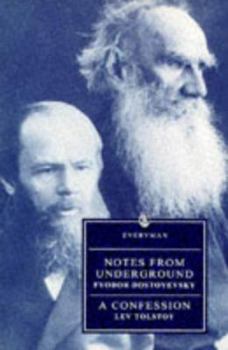
Notes from Underground

In these two short works, Russia's greatest novelists ruthlessly tackle the subject of their mid-life crisis. In his novella Dostoyevsky creates a nameless rebel, the man from underground for whom the... This description may be from another edition of this product.
Format:Paperback
Language:English
ISBN:0460874489
ISBN13:9780460874489
Release Date:June 1994
Publisher:Tuttle Publishing
Length:256 Pages
Weight:0.43 lbs.
Dimensions:0.6" x 5.1" x 7.8"
Customer Reviews
5 ratings
A Slime of His Time
Published by Thriftbooks.com User , 23 years ago
The first words of this deeply disturbing, but powerful, novel are "I am a sick man....I am a spiteful man." and these may refer equally to the main character and to the author. Dostoevsky has written an amazing portrait of a loner, whose introverted, sick thoughts spill out on the pages in demented brilliance. The novel is a product of European cynicism, nihilism, and inertia, all of which reached a certain height in the paralyzed upper circles of 19th century Russia. Nobody could write such a book without some personal acquaintance with the mean moods of this anti-hero. The main character, who does nothing except hide from the world, is a total misfit, a loser in life at home, at work, and in love---a jerk, a dweeb, a dork, a geek in modern American parlance---yet through Dostoyevsky's clear prose, we see into his wounded soul. "Actually, I hold no brief for suffering, nor am I arguing for well-being." he writes, "I argue for...my own whim and the assurance of my right to it, if need be." He is apart from society, recognizes no social obligation. He argues that suffering is still better than mere consciousness, because it sharpens the awareness of your being, therefore suffering is in man's interest Someone who can argue that is not going to write an average novel. This is in fact not an average novel at all, but a book concerned with the play of ideas, ideas that flash around like comets and meteorites inside Dostoevsky's head. It can no more escape Dostoevsky's brain than a Woody Allen movie can escape Woody Allen. The plot line of NOTES FROM UNDERGROUND is extremely slim. It concerns an underground man, a man like a rat or a bug, who lives outside, or more likely, underneath the world's gaze. It is a lonely, tortured life lived inside a single skull with almost no contacts with the rest of the world except for a vicious servant. The "action" of the book comes only when the protagonist worms his way into a dinner with former schoolmates. They don't want him, he despises all of them. So, as you can imagine, a good time is had by all. The underground man winds up in a brothel with an innocent, hapless prostitute named Liza. He wishes for some relationship, he immediately abhors the very thought of contact with another person. The result is worse than you can predict, though I will say that it involves "the beneficial nature of insults and hatred". In the tradition of novels of introspective self-hatred, Dostoevsky's has to be one of the first. I wondered as I read how much Kafka owed him, for after all, the hero here is a cockroach too, only remaining in human form. I realized how much Dostoevsky had influenced the Japanese writers of the 20th century---Tanizaki, Mishima, Soseki, Kawabata, and others. The pages are brilliant, but full of vile stupidity, useless, arid intellectualism, hatred of one's best and love of one's worst qualities, withdrawal from life, and self-loathing. A less American novel would be hard to ima
One of Dostoevsky's Best
Published by Thriftbooks.com User , 23 years ago
First my confession: the first two encounters with this celebrated novella both ended with the book being rudely dismissed across the room near pg. 30. But ahh, the third reading felt positively as if a portable supernova had detonated between my two hands. My duty then as a reviewer is to tell you how you should approach this book and ultimately convince you to read it.The most important thing you need to know about this book is that it is a POLEMICAL SATIRE. There is a great ideological distance between the narrator and Dostoevsky - in no way does he reflect the author's outlook. This fact is not obvious seeing that even his contemporaries were perplexed and generations of critics stymied. The opponent of Dostoevsky's polemic is the radical socialist Chernyshevsky, whose novel "What is to be Done?" (incidentally, Lenin's favorite novel) is parodied piecemeal throughout the novella. What the underground man represents is the logical extreme of a man who totally embraces Chernyshevsky's "rational egoism" and its socialist program. Chernyshevsky believed that once man is shown the truth through science and reason, the "new man" will inevitably renounce all irrational behavior. He also proposes that a new society be founded on socialist and materialistic principles, where the individual will is subjected for the betterment of humanity. In this book, Dostoyevsky seeks to undermine Chernyshevsky by showing that a strict adherence to this radical thought ends in a terrible cul de sac called the "man from underground". Where it diverges from being a mere satire is the fabulous and tortuous dialogue-monologue of this embittered man. Although Chernyshevsky's overconfidence in science seems incredibly naïve to us now, this was certainly not the case in the 1860's. For example, the book mentions H.T. Buckle, an ambitious historian who attempted to "promote" history to an analytical science (for the refutation, consult Isaiah Berlin's "Proper Study of Mankind), as a living influence. The underground man, then, stands as nineteenth century's most heartfelt rebellion against this atmosphere of stifling rationality. But why should belief in science lead to rigor? Take the following reasoning offered by the narrator. Someone slaps him and he feels offended. But the "rational" part of him tells him that, according to "natural law" and scientific determinism, the slap is the result of environmental factors. Thus the offender is blameless because "the laws of nature cannot be forgiven" (pg.9). But then what is he to do with the resentment that he feels? This leads him a little later to the following wonderful outburst: "My God, but what do I care about the laws of nature and arithmetic if for some reason these laws and two times two is four are not to my liking?" (pg.14). An entirely logical universe where human action is governed by something "like a table of logarithms" (pg. 24) leads to a false comfort in moral relativism. This still does not mean that the und
A Celebration of Freedom and the Irrational.
Published by Thriftbooks.com User , 23 years ago
This short novel has relevance for any individual who chooses to grapple with the onslaught of information that pours forth from various institutions, including modern education and the media. I had read ~Notes from the Underground~ many years ago, and picking it up again proved to be a positive move, philosophically, politically and socially, on a very personal level. The narrator is a 19th century man who has chosen to withdraw from society and rant and rave in a kind of 'neurotic' protest against the ever-prevalent 'rational forces' or normalizing conditions that society is imposing. In brief, his protest is against the popular philosophical view of the time, deterministic materialism. He asks: Is man a free agent? Are his actions and desires his own; or conversely, is he endowed with some Universal nature, where his interests, desires and overall behaviour is predetermined? In his terms, are we "Piano keys", or merely "Organ stops" responding blindly to the 'rational forces' that continually bombard us on a daily basis?This book is an argument supporting the view that irrationality has its merits. We are in danger of ignoring our own desires in favour of a popular or dominate view. What the underground man is proposing is to be aware of the danger of buying into the proposition that there is a collective 'common good', that all people are essentially the same and desire the same things. He goes on to warn that if the men of 'science' are correct, if our desires and interests are the same, if our behaviour can be recorded on some central data base, where all we have to do to understand how we should behave is by logging onto this data base, what hope does humankind have of experiencing individual needs, creativity, adventure and innovation? According to the underground man, absolutely no hope at all.The American philosopher, William James, had grappled with the same argument around the same time that this novel was written. He recorded in his diary that his first act of free will was to believe he had free will, and began his new life on that simple but important premise.Freedom for William James and the underground man is the highest most valuable aspect of our existence. The underground man believed that it was absolutely imperative that we at times go against our 'best interests' even if our free will is an illusion. When considering the barrage of information that continually comes our way, we should attempt to separate the 'wheat from the chaff' according to our desires, beliefs and will - a word of advice from a 19th century 'neurotic'.It is impossible to illustrate the many facets of this important novel in the limited space provided. Therefore I urge you to open ~Notes from the Underground~ and submerge yourself into the ideas and arguments it proposes we consider.
More with the Mad Genius.........
Published by Thriftbooks.com User , 25 years ago
Quick read? I finished Crime and Punishment and thought I'd zip through Notes like a snack before going on to the Brothers Karamozov, afterall, it's barely over 100 pages. Quick read? Think again.Imagine being locked in a very small room with a verbose, insane, brilliant, jaded, before-his-times, clerk-come-philosopher....with a wicked sense of humor, and a toothache that's lasted a month. Pleasant company....are you searching for the door yet?For the first hour, he's going to rant about his philosophy of revenge, the pointlessness of his life, his superiority, his failure, oh yeah, and his tooth. FOr the second half of the book, he's going to tell you a tale, with the title "Apropos of the Wet Snow". Because of course, there's wet snow outside on the ground.I will leave you with this encouragement. If you can get through this book, you will appreciate Doestoevsky more, understand Crime and Punishment better, and probably enjoy a good laugh more than once. Notes from the Underground is not light reading, but it is well worth the effort. And the translation by Pevear, including the translators notes at the back, is excellent.
Story and toughts of a self made social outcast.
Published by Thriftbooks.com User , 29 years ago
A seemingly in-depth look into the life of a depressive recluse. The main character gives us many views on everyday people and their actions that should cause us, the reader, to evaluate our own understanding of the people who surround us. (Example: Why people will moan for days before seeing a dentist.) The writing is absolutely brilliant. Dostoyevsky does not seem to have created this character but instead pulled him from the street. The character was not one dimensional, an attribute that I found personally refreshing . The thoughts and emotions are complex and real and were constantly understated, adding to the impression that the book was written by the character himself, who lacks writing experience needed to capture these feelings. The main character views himself cut off and removed from society, rejected by all in nearly every way. He has become so obsessed with this notion that he has created this exact situation as a result of searching for justification of this impression. He has in fact created most of his own misery, and only continues to propagate more. Yet he seem himself as miserable and rejected and finds pride in this image. He imagines himself to be pitiful and also to be strong and fiercely independent as a result of his social isolation. He feels he poses a strength of spirit for being able to endure the loneliness and envisions himself as a martyr. This fuels his ego and he plans heroic acts in order to show the proof of his worth or to win attention and love. He however lacks the courage to complete the monumental self serving tasks he set before himself. Through a strange twist of logic these failures are also seen as something to be admired. It only makes him more pitiful and thus a greater martyr. When these failures are personally humiliating he retreats within in himself. Hating everyone and again fortifying his independence, claiming that all who depend on others are weak. Only to re-emerge more hungry for the affections of a companion. An emotional ebbing between pride of independence and ability to bravely endure the suffering quickly switching to the opposite pole of resenting people in general. Sustaining himself on the imagined praises or pity that he thinks would be lavished upon him if he were to be seen by others as he sees himself. A terribly tragic tale that emphasis the importance of perspective and removing one's self from a problem in order to perhaps gain a helpful assessment of it. The ideas and emotions presented give a haunting impression. The book should be read slowly and turned over in ones mind again and again.
Copyright © 2026 Thriftbooks.com
Terms of Use | Privacy Policy | Do Not Sell/Share My Personal Information | Cookie Policy | Cookie Preferences | Accessibility Statement
ThriftBooks ® and the ThriftBooks ® logo are registered trademarks of Thrift Books Global, LLC
ThriftBooks ® and the ThriftBooks ® logo are registered trademarks of Thrift Books Global, LLC
