


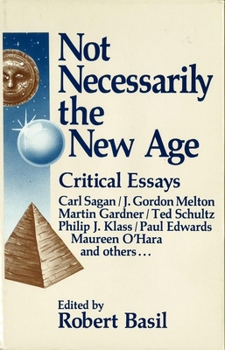
Not Necessarily the New Age


The New Age movement had its origins in the youth movement of the 1960's, when the "Age of Aquarius" promised the coming of a new millennium. But this elusive, utopian state of affairs has yet to materialize, points out editor Robert Basil. Should we be surprised?More than 25 years after the counterculture discovered its first taste of a new spiritualism, the baby-boom generation - possessed of incredible social influence and buying power - is feverishly embracing the paraphernalia of "higher" consciousness: New Age books, magazines, catalogues, audiotapes, videotapes, seminars, physical and mental therapies, crystals, Eastern gurus, channeled entities, "socially conscious" investment services, and spiritual "supplies."In short, what used to be called "the occult" (which means "hidden") is occult no longer, nor is it confined to a lunatic fringe. Rather, as traditional, institutional religion has lost its power as an adequate guide to one's spiritual quest, belief in New Age phenomena has moved into the mainstream, becoming a major force in America's spiritual life.Although the New Age movement has taken on a veneer of precision by its prolific use of "scientific" terms, it does, in fact, represent a large-scale renunciation of science. And, because the scientific attitude toward the New Age often takes the form of immediate dismissal, New Agers claim that scientists lack an open mind about their experiences.Not Necessarily the New Age steps into the void between New Age nonsense and scientific disdain. With contributions by Carl Sagan, Martin Gardner, Philip J. Klass, Marc Medoff, J. Gordon Melton, and many others, this analysis and examination of the New Age is thorough, rigorous, and fair - and offers multifaceted and balanced explanations about a movement that, until now, has been far too slippery to be pinned down.
Format:Hardcover
Language:English
ISBN:0879754907
ISBN13:9780879754907
Release Date:October 1988
Publisher:Prometheus Books
Length:395 Pages
Weight:1.65 lbs.
Dimensions:1.4" x 6.3" x 9.3"
Customer Reviews
1 rating
Sympathetic skeptics
Published by Thriftbooks.com User , 18 years ago
I once knew a woman who lived a dreary life, alone in a dreary city. She believed in Eckankar (whose "pope," then Shri Darwin Gross, resided in the holy city of Menlo Park, Calif.) and astral traveling. Each weekend she would travel astrally to Mongolia (why she picked there I never could guess), and when she returned to her small apartment in time to dress for work on Mondays, the apartment would have been cleaned while she was away. Well, it worked for her, but if I were to throw out 5,000 years of civilized thinking, I would want something better in return than cosmic maid service. There is a new breed of "understanding" skeptic, represented in "Not Necessarily the New Age," that would like to explain to people like the Mongolian tourist what is "really" happening to them. The 18 essayists in this book believe that non-believers should stop hooting at cranks and fuzzy thinkers. Hooting, of course, has not had any positive effect, from the rationalist point of view, since all surveys show an increase in New Age beliefs. (One finds that 65 percent of Americans believe in reincarnation, while at least as many claim to be Christians. You can't do both, so a minimum of 30 percent of the population is holding religious beliefs that could be described most kindly as incoherent.) But is there any reason to think that a more sympathetic approach would have a better effect? Take Susan Blackmore, whose investigations of New Age phenomena, primarily OBE or out-of-body experiences, are widely respected by rationalists as revealing, thorough, imaginative and conclusive. In her essay, she dismisses "crude skepticism," which typically dismisses OBEs as "hallucinations." There is nothing crude about crude skepticism. Dismissing OBEs involves a thought process that a rationalist navigates so quickly that he may not realize how he got from A to B. He reasons thus: If OBEs are possible, then everything I think I know about how the universe behaves is wrong; and that could be so; but if it were so, I would expect it to show up in some non-trivial way; and since even believers treat it as a parlor trick, it is probably just a hallucination of a rather boring kind and not worth further trouble. Blackmore, who disagrees with that sort of reasoning, spent most of the '80s figuring out OBEs, and guess what? They're hallucinations of a not very interesting sort. As time-waster that doesn't compare with meditation, but what does? There is nothing crude about evaluating phenomena on the basis of the accumulated, tested experience of 200 generations of intelligent investigations; and, in fact, all New Agers do the same when they think the skeptics are not looking. No matter how scornful they claim to be of "Western linear, right-brained science," when they go to the airport to fly someplace, they bet their lives on the reality of Western, linear, right-brained aeronautical engineers. Eastern Non-linear Left-brained Airlines has not yet perfected the shuttle, no matter wha
Copyright © 2025 Thriftbooks.com
Terms of Use | Privacy Policy | Do Not Sell/Share My Personal Information | Cookie Policy | Cookie Preferences | Accessibility Statement
ThriftBooks ® and the ThriftBooks ® logo are registered trademarks of Thrift Books Global, LLC
ThriftBooks ® and the ThriftBooks ® logo are registered trademarks of Thrift Books Global, LLC
