


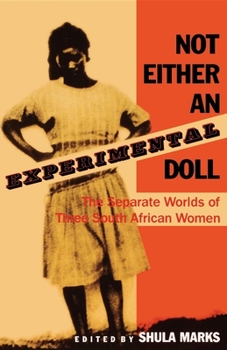
Not Either an Experimental Doll: The Separate Worlds of Three South African Women


Select Format
Select Condition 
Book Overview
"... remarkable... " --Foreign Affairs "... illuminates the workings of institutionalized racism through the correspondence of three South African women in the 1940s and '50s." --Feminist Bookstore News "The history of a place and time is made vivid by the combination of the rich personal record of the letters and the theoretically framed analytic discussion. The result is new insight into the history of black education in South Africa, and a revealing study of the dynamics of women's relations under colonialism across the lines of race, age and power." --Susan Greenstein, The Women's Review of Books "A riveting and revealing book--one in which few of the characters wear hats that are spotlessly white." --Third World Resources "This rich collection of letters deserves its own reading, as do Shula Marks's bracketing essays. They are invaluable for clarifying the myriad ramifications that the letters raise for African women." --International Journal of African Historical Studies "... powerful and perceptive....speak s] eloquently to a Western audience that is poised to deal with the political and personal lives of South African women in an intimate holistic fashion." --Belles Lettres The roots of modern Apartheid are exposed through the painful and revealing correspondence of three very different South African women--two black and one "liberal" white--from 1949 to 1951. Although the letters speak for themselves, the editor has written an introduction and epilogue which tell of the tragic ending to this riveting story.
Format:Hardcover
Language:English
ISBN:0253348439
ISBN13:9780253348432
Release Date:December 1988
Publisher:Indiana University Press
Length:256 Pages
Weight:0.68 lbs.
Dimensions:8.5" x 0.5" x 5.8"
Customer Reviews
2 ratings
a fascinating journey
Published by Thriftbooks.com User , 25 years ago
What a wonderful book! The exchange of letters is nothing less than fascinating. By reading these letters not only does one get a sense of the racial and economic divisions between the writers, but a glimpse is gained into what would be a peculiar exchange of correspondence even now: a seventy-something woman of well-intentioned but often misguided motives and a teenaged girl perplexed with all the rampant emotions and self-absorbtions of her age. I cannot stress how inportant I feel it is to read the introduction by Shula Marks AFTER reading the letter exchange. Anyone who has even a fundamental knowledge of South Africa during this time would do better not to read the intro first. It's better to get caught up in the flow of the letters--and let their story unfold unadulterated. There is an almost voyeuristic aspect to them as they come to their conclusion. I highly recommend this book, and not only to those with an interest in South Africa or Womens' History either.
a fascinating journey
Published by Thriftbooks.com User , 25 years ago
What a wonderful book! The exchange of letters is nothing less than fascinating. By reading these letters not only does one get a sense of the racial and economic divisions between the writers, but a glimpse is gained into what would be a peculiar exchange of correspondence even now: a seventy-something woman of well-intentioned but often misguided motives and a teenaged girl perplexed with all the rampant emotions and self-absorbtions of her age. I cannot stress how inportant I feel it is to read the introduction by Shula Marks AFTER reading the letter exchange. Anyone who has even a fundamental knowledge of South Africa during this time would do better not to read the intro first. It's better to get caught up in the flow of the letters and let their story unfold unadulterated. There is an almost voyeuristic aspect to them as they come to their conclusion. I highly recommend this book--and not only to those with an interest in South Africa or Womens' History.
Copyright © 2026 Thriftbooks.com Terms of Use
| Privacy Policy | Do Not
Sell/Share My Personal Information | Cookie Policy | Cookie Preferences | Accessibility Statement
ThriftBooks® and the ThriftBooks® logo are registered trademarks of Thrift Books Global, LLC
ThriftBooks® and the ThriftBooks® logo are registered trademarks of Thrift Books Global, LLC
