


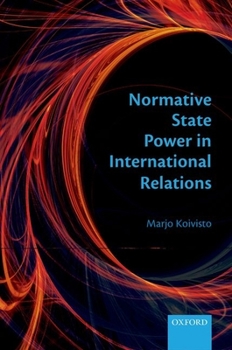
Normative State Power in International Relations
No Customer Reviews

While the relationship between norms and the state is an omnipresent research theme in International Relations, most international theory - from classical liberalism to recent constructivism - continues to treat 'normative state power' as an analytical impossibility. Scholarship within the fields of human rights, global civil society, and globalization remains primarily focused on moral evaluations and the mitigation of the geopolitical power of the state. Rarely are the normative institutional capacities of the state the focus of analysis. This book offers a new theory of normative state power in global politics. Marjo Koivisto argues that normative state power is distinct from the fiscal or military might of states. It is usually institutionalized and internalized within the state as a set of cultural norms relating to the role of statehood in local and global practice. By deploying both theoretical inquiry and substantive analysis of the Nordic model, the book offers a deep, institutionalist account of normative state power as exercised in relation to the welfare state. A case study of the internationalist networks of the Nordic states in times of economic crises (both the 1930s and 1990s) illustrates how, thanks to the persistence of normative state power, state forms tend to outlast political and economic transformations.
Format:Hardcover
Language:English
ISBN:0199652791
ISBN13:9780199652792
Release Date:November 2012
Publisher:Oxford University Press (UK)
Length:226 Pages
Weight:1.15 lbs.
Dimensions:0.7" x 6.0" x 9.2"
Customer Reviews
0 rating
Copyright © 2026 Thriftbooks.com Terms of Use
| Privacy Policy | Do Not
Sell/Share My Personal Information | Cookie Policy | Cookie Preferences | Accessibility Statement
ThriftBooks® and the ThriftBooks® logo are registered trademarks of Thrift Books Global, LLC
ThriftBooks® and the ThriftBooks® logo are registered trademarks of Thrift Books Global, LLC
