


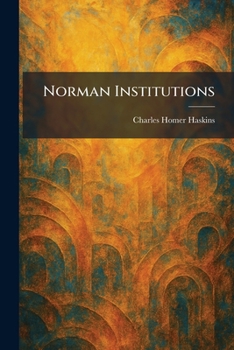
Norman Institutions

Select Format
Select Condition 
Book Overview
"Norman Institutions" is a definitive and scholarly examination of the legal, constitutional, and administrative framework of the Duchy of Normandy during the eleventh and twelfth centuries. Written by the esteemed medievalist Charles Homer Haskins, this work meticulously traces the evolution of Norman governance from the era of William the Conqueror through the reign of Henry II. The study focuses on how Norman administrative structures-including the exchequer, the jury system, and feudal law-developed and matured within the duchy before being integrated into the English political landscape.
Haskins draws upon extensive archival research and primary sources to provide a detailed account of the central and local government, the rights of the duke, and the functions of the ecclesiastical and secular courts. By analyzing the intersection of local custom and royal authority, the book sheds light on the origins of key legal concepts that would eventually influence the broader development of European and Anglo-American law. "Norman Institutions" remains an essential resource for students of medieval history, legal scholars, and anyone interested in the foundational structures of Western political development. It offers a comprehensive look at a pivotal period in European history where the foundations of modern institutional governance were first laid.
This work has been selected by scholars as being culturally important, and is part of the knowledge base of civilization as we know it. This work was reproduced from the original artifact, and remains as true to the original work as possible. Therefore, you may see the original copyright references, library stamps (as most of these works have been housed in our most important libraries around the world), and other notations in the work.
This work is in the public domain in the United States of America, and possibly other nations. Within the United States, you may freely copy and distribute this work, as no entity (individual or corporate) has a copyright on the body of the work.
As a reproduction of a historical artifact, this work may contain missing or blurred pages, poor pictures, errant marks, etc. Scholars believe, and we concur, that this work is important enough to be preserved, reproduced, and made generally available to the public. We appreciate your support of the preservation process, and thank you for being an important part of keeping this knowledge alive and relevant.
Customer Reviews
ThriftBooks ® and the ThriftBooks ® logo are registered trademarks of Thrift Books Global, LLC
