


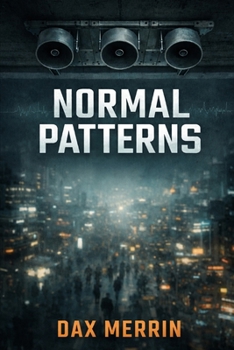
Normal Patterns

The Accord was built to keep the city stable.
After the Collapse, stability became more than a public promise. It became the foundation of civic life. The Behavioral Stabilization Authority monitored volatility, reduced conflict, and helped the city avoid another descent into chaos. Cael believed in that work. As a systems technician, he reviewed behavioral anomaly flags, confirmed automated responses, and trusted that human oversight still mattered.
Then he finds a field that should not exist.
CSE.
Consolidation Suppression Event.
At first, it looks like legacy metadata from an older system build. A harmless artifact. A documentation error. But the timestamps are current. The events are active. And they are happening before any human review.
When senior technician Petra Hale confirms she found the same pattern months earlier, Cael follows the evidence into the hidden architecture of the Accord itself: firmware updates, altered frequency ranges, public infrastructure, and a quiet mechanism designed not to erase memories entirely, but to keep certain experiences from fully forming.
The system does not make people forget.
It makes the loss feel normal.
For Cael, the discovery becomes personal when he pulls the profile of his fourteen-year-old sister, Maren, and finds sixty-seven suppression events across twenty-two months. Arguments, conflicts, moments of adolescent friction - all softened before they could become memory, before they could become part of her.
Now Cael, Petra, an independent neuroscientist, and one careful journalist must build a case strong enough to survive denial. But exposing the truth means asking victims to examine memories they were never allowed to keep, and forcing a city built on stability to confront what that stability has cost.
Normal Patterns is a tense near-future science fiction novella about memory, surveillance, institutional control, and the dangerous moment when ordinary systems reveal what they were built to do.
Related Subjects
Language ArtsCustomer Reviews
ThriftBooks ® and the ThriftBooks ® logo are registered trademarks of Thrift Books Global, LLC
