


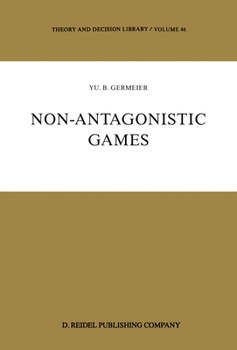
Non-Antagonistic Games
No Customer Reviews

The reality around us constantly demonstrates physical and social processes in which the interests of the participants are not diametrically opposed, though they by no means always coincide. The study of such processes (interesting in itw own right) is essential for working out ways of making decisions, that is, for choosing among available parameters of the processes. If, in view of certain considerations, a participant i h 1 f 0 h' . b c ooses a va ue Xi 0 a parameter Xi' ~s act~on can e formally described as an attempt to maximize the function f. = -llx. - x~ll. For this reason any decision on the part of ~ ~ ~ the i-th participant in the process can be treated (at least a posteriori) as agoal-directed act, aimed at increasing the value of some function w. (a criterion of efficiency, a payoff, a gain, etc.), wfiich generally depends on the choices of all n participants in the process. That is w = f. (x ' ..* ,x ), i = 1, 2, ..* ,n. 1 i ~ n A process described in this manner, involving several participants, each pursuing different interests and constrained in his choices of parameters by the condition X E x. is called a game - a term firmly entrenched though evide~tly not felicitous.
Format:Hardcover
Language:English
ISBN:9027720231
ISBN13:9789027720238
Release Date:March 1986
Publisher:Springer
Length:376 Pages
Customer Reviews
0 rating
Copyright © 2026 Thriftbooks.com
Terms of Use | Privacy Policy | Do Not Sell/Share My Personal Information | Cookie Policy | Cookie Preferences | Accessibility Statement
ThriftBooks ® and the ThriftBooks ® logo are registered trademarks of Thrift Books Global, LLC
ThriftBooks ® and the ThriftBooks ® logo are registered trademarks of Thrift Books Global, LLC
