


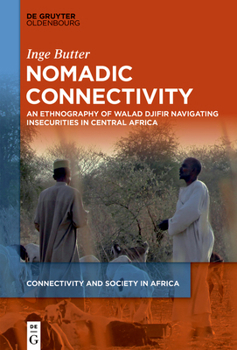
Nomadic Connectivity: An Ethnography of Walad Djifir Navigating Insecurities in Central Africa
No Customer Reviews

Select Format
Select Condition 
Book Overview
A focus on the everyday has produced this ethnography, which hopes to give a nuanced voice to an extended family of semi-sedentary nomads, living at the centre of a country and region known for its political turmoil, ecological insecurities, and socio-economic hardship. The everyday of the Chadian Walad Djifir is one in which sedentarity and mobility are approached as two entwined parts of a whole, and where economic and geographical boundaries do not necessarily form constrictions. The ferīkh (nomadic camp) is where all of the Walad Djifir's networks meet, and often also begin-- a physical place embodying various networks and connections, which span time and geographical space. This analytical and methodological approach gives insight in how regional trends can be understood in light of the Walad Djifir's daily lives. Over time, the Walad Djifir have developed ways of coping and dealing with insecurities, interacting with infrastructural, technological, and socio-political developments in specific ways. In exploring how such insecurities and crises become anchored into the everyday, the ferīkh provides answers. It is precisely the mundane elements of daily life which anchor disruption.
Format:Paperback
Language:English
ISBN:3112213734
ISBN13:9783112213735
Release Date:June 2025
Publisher:de Gruyter Oldenbourg
Length:253 Pages
Weight:0.80 lbs.
Dimensions:0.5" x 6.1" x 9.2"
Related Subjects
HistoryCustomer Reviews
0 rating
Copyright © 2026 Thriftbooks.com Terms of Use
| Privacy Policy | Do Not
Sell/Share My Personal Information | Cookie Policy | Cookie Preferences | Accessibility Statement
ThriftBooks® and the ThriftBooks® logo are registered trademarks of Thrift Books Global, LLC
ThriftBooks® and the ThriftBooks® logo are registered trademarks of Thrift Books Global, LLC
