


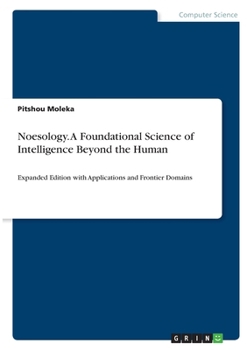
Noesology. A Foundational Science of Intelligence Beyond the Human: Expanded Edition with Applications and Frontier Domains
No Customer Reviews

Document from the year 2026 in the subject Computer Sciences - Artificial Intelligence, grade: 19, language: English, abstract: Intelligence occupies a paradoxical position in modern knowledge systems. It is simultaneously one of the most frequently invoked concepts across scientific, technological, political, and cultural discourses, and one of the least conceptually stabilized. For more than a century, intelligence has been measured, modeled, simulated, optimized, and debated, yet it has never been consolidated into a unified scientific object with clear ontological, epistemological, and methodological boundaries. The absence of such consolidation has produced a fragmented intellectual landscape in which intelligence is alternately treated as a psychometric variable, a neurological function, a computational capacity, an evolutionary adaptation, or a philosophical abstraction, depending on disciplinary context. This fragmentation is not merely terminological; it reflects a deeper structural limitation in contemporary science, namely the lack of a dedicated discipline capable of studying intelligence as a phenomenon in its own right rather than as a secondary attribute of other processes. The earliest systematic attempts to study intelligence emerged within psychometrics, particularly through the work of Alfred Binet and Th odore Simon in the early twentieth century, who sought to quantify intellectual abilities for educational purposes (Binet & Simon, 1905). While historically significant, this approach implicitly reduced intelligence to testable cognitive performance within culturally specific frameworks, a limitation later exposed by Stephen Jay Gould's critique of reification and measurement bias in intelligence testing (Gould, 1981). Subsequent theoretical expansions, such as Charles Spearman's concept of general intelligence and Howard Gardner's theory of multiple intelligences, broadened the scope of what might count as intelligence but did not resolve the
Format:Paperback
Language:English
ISBN:3389174990
ISBN13:9783389174999
Release Date:January 2026
Publisher:Grin Verlag
Length:274 Pages
Weight:0.73 lbs.
Dimensions:0.6" x 5.8" x 8.3"
Customer Reviews
0 rating
Copyright © 2026 Thriftbooks.com
Terms of Use | Privacy Policy | Do Not Sell/Share My Personal Information | Cookie Policy | Cookie Preferences | Accessibility Statement
ThriftBooks ® and the ThriftBooks ® logo are registered trademarks of Thrift Books Global, LLC
ThriftBooks ® and the ThriftBooks ® logo are registered trademarks of Thrift Books Global, LLC
