
Skip to content
Scan a barcode
Scan
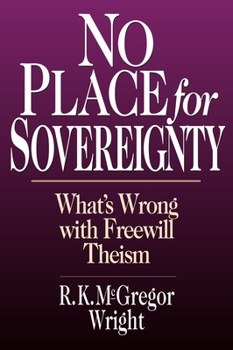
Paperback No Place for Sovereignty: What's Wrong with Freewill Theism Book

ISBN: 0830818812

ISBN13: 9780830818815

No Place for Sovereignty: What's Wrong with Freewill Theism

Select Format

Select Condition ThriftBooks Help Icon

Recommended

Format: Paperback

Condition: Very Good

$7.39
Save $24.60!
List Price $31.99
Almost Gone, Only 2 Left!

Book Overview

In recent years an increasing number of evangelical thinkers have called for a reevaluation of our understanding of God, making a case for what has variously been called "freewill theism" or the "open view" of God. R. K. McGregor Wright sees their efforts not as something radically new, but a contemporary reaffirmation of Arminianism.Concerned that evangelicals may soon find no place for sovereignty in their thinking, Wright sets out to show what's wrong--biblically, theologically and philosophically--with freewill theory in its ancient form. Along the way, he provides a short course in historical theology, making a fresh, powerful case for the Reformed emphasis on God's sovereign grace. Wright also meets challenges head-on with a discussion of the Arminian position and a chapter on the problem of evil. Finally, he subjects to close scrutiny the recent work of Clark Pinnock, a contemporary advocate of freewill theism.Regardless of where readers' sympathies lie, they will want to hear, think through and respond for themselves to the arguments Wright makes on behalf of the Reformed understanding of God.

Customer Reviews

5 ratings

Many gold nuggets found

I read this book a number of years ago during the "formative" years of my theological understanding. This book helped to strengthen and solidify my views in favor of a reformed anthropology. I have read several other books on this same topic sense that time but I still believe that this is one of the best if not the best I've read (especially among contemporary treatments of this topic). Sure it is technical and challenging throughout, but for the patient reader who is willing to put in the time and effort required to mine the rich gold found here, it will be well worth your endeavor. It is biblically founded and philosophically sophisticated and sound.

Still the best

Published in 1996: Eight years later, this is still the best book on the subject, and will continue to be for a very long time. This book is excellent. Regarding the final two chapters, that some find out of place and rushed, I have to disagree: it is the only place in the literature where I found a meaningful and reasonable explanation of the questions of evil and ultimacy, which are the essential issues where the debate ends up every time. Of course, anyone opposed to the concept of being under God's sovereignty will find this book abhorrent.

Thought Out and Scripturally Based

Wright's book shines as a book that is both thought out and based squarely on Scripture, and for that he deserves to be commended. He states accurately that evangelical Christianity is too quick to accept contradictions where none is needed and explain them away as mystery simply to hold extrabiblical presuppositions.I must respectfully disagree with the previous review of this book (johniii) and say that Wright's insistance on logical continuity is reasonable. Wright is not against the plain interpretation of Scripture, but what he is saying is that Scripture is not going to logically contradict itself, and if you have a presupposition (e.g. free will) that, when taken to its logical conclusion, contradicts Scripture, then the presupposition must be wrong (because Scripture is certainly right). He may overemphasize logical continuity to an extent, but I would give him a little room there considering that most evangelical Christians ignore the concept completely and that problem is far worse.Wright makes every effort to ensure that his thesis is Scriptural (and I believe it is) and to back it up with all means that are appropriate. His book, although not a good starting point for those interested in predestination or free will (as it IS very technical and scholarly in nature), is a must-read for those who have already delved into the subject.

Excellent and comprehensive treatment

Dr. Wright and I were friends when we both lived in Denver, Colorado. We have both since moved to different states, although I have maintained some sporadic contact with him.No Place for Sovereignty is Dr. Wright's first book. And it is sure to be controversial! Dr. Wright takes head-on the Arminian notion of human "freewill."In the very helpful Glossary at the end of the book, "Freewill theory" is defined as "View that the human will is free to act independently of divine control or external causation. Arminians usually define it as the ability to choose good or evil equally. Hence, `the liberty of indifference'" (p.236).But is this concept true? Or more to the point for Christians, is it Biblical? Most Christians just assume that it is. But Dr. Wright demonstrates that this idea has more in common with Greek notions of autonomy than the Bible.The book is divided into eleven chapters. Chapter One begins with a quick historical overview of the freewill controversy, from the time of the Apostolic Fathers to the present.Dr. Wright then lists five reasons people believe in the freewill theory: 1. If we have no free will, we are not responsible for our actions. 2. It is essential to the image of God. 3. The denial of free will undermines both human effort and morality. 4. The Bible teaches free will. 5. Free will gets God off the hook in the problem of evil (pp.40,41).Subsequent chapters then show that each of these claims is faulty, both logically and Biblically. In regards to the first claim, Chapter Two shows that a will "free" in the Arminian sense would not be responsible as it would be no different than chance. Responsibility is based on what God decides, not on what we decide.As for the imago Dei, Chapter Three presents a study of passages in the Bible in which it is discussed. Dr. Wright concludes, "Throughout all the biblical references to the image of God, its loss in the Fall and its restoration in Christ, not a hint appears that the image necessarily includes anything recognizable as free will. The Bible simply does not use the idea of free will as an explanatory category at all" (p.76).Chapter Four looks at Genesis chapter three and the Fall. It focuses on Eve's conversation with Satan and shows it was her desire to be autonomous from God that lead to her disobedience. Some consequences of the Fall are then noted.As for human effort and morality, Dr. Wright states, "... freewill theory destroys any hope of relating human action to God's sovereignty and makes human action purely a chance affair" (p.40). These ideas are elaborated on in Chapter Five.As for whether freewill theory is Biblical, Dr. Wright correctly notes that if any of the Five Points of Calvinism are true, then there can be no freewill in the Arminian sense. Chapters Six to Eight are then devoted to Biblical proofs of the Five Points of Calvinism.Then Chapter Nine addresses the question, "Are there any `Arminian verses' in the Bible?" The chapter soundly exegetes supposedly

Good intro to calv-armin debate in apologetics

This book was written to acquaint the doctrinally-concerned christian with a biblical, philosophical and historical defense of the Calvinist view of salvation, to show how Arminianism depends on an incoherent and unbiblical "freewill theory," and how belief in a libertarian view of free will inevitably leads to a finite God. A reviewer in Christian Scholars' Review said that it was a good clear explanation accessible to any intelligent reader. He also noted that it failed to take into account recent philosophical discussion of "compatibilist" views of free will with divine sovereignty. This is because 1) the author was not primarily addressing professional philosophers, but rather those believers with no special philosophical training, 2) he does not believe most of these theories, except those that redefine "free will" to make it compatible with the Bible's sovereignty teaching, and 3) there is no point trying to reconcile logical contradictions; it's better to abandon one side to avoid irrationalism. The book offers usable arguments from the Bible against Arminianism, and tries to show that no Christian apologetic can succeed that is based on an unquestioned acceptance of the assumption of human autonomy. Historically, Arminianism is really only a form of humanism.
Copyright © 2026 Thriftbooks.com Terms of Use | Privacy Policy | Do Not Sell/Share My Personal Information | Cookie Policy | Cookie Preferences | Accessibility Statement
ThriftBooks® and the ThriftBooks® logo are registered trademarks of Thrift Books Global, LLC

GoDaddy Verified and Secured