


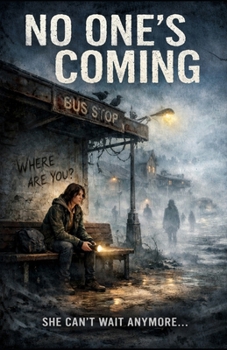
No One's Coming

In No One's Coming: The Fog That Waits, Mara remains in a decaying coastal town where a thick, unnatural fog traps those who wait for rescue. Anchored by a promise from her missing brother, she returns daily to an abandoned bus station, convinced someone will come. But the longer she stays, the more reality distorts-voices echo from nowhere, messages appear carved with her name, and figures emerge from the mist. She discovers that the town does not physically imprison people; instead, it feeds on expectation, shaping illusions from memory, hope, and unresolved attachment to keep its victims waiting indefinitely.
As Mara searches for answers, she uncovers evidence of others who were trapped before her-names carved into walls, warnings left behind, and patterns that reveal how the place operates. The fog reflects what people cannot let go of, turning loved ones, promises, and fears into convincing illusions. Even her brother appears, not as a true presence, but as a manifestation of her refusal to accept his absence. Through trial and error, Mara learns that reacting to the fog-believing it, questioning it, or trying to solve it-only strengthens its hold. The only way forward is to stop engaging with it entirely.
In the end, Mara escapes not through rescue, but through a shift in understanding. She abandons the need for answers, closure, and confirmation, and simply walks forward without reacting to the illusions around her. By letting go of the belief that someone is coming to save her, she breaks the cycle that kept her trapped. Emerging into the real world, she realizes that the true prison was not the fog itself, but the act of waiting. Free at last, she continues on without certainty of what lies ahead-only the knowledge that she no longer needs to stand still and hope for someone else to lead her out.
Customer Reviews
ThriftBooks ® and the ThriftBooks ® logo are registered trademarks of Thrift Books Global, LLC
