


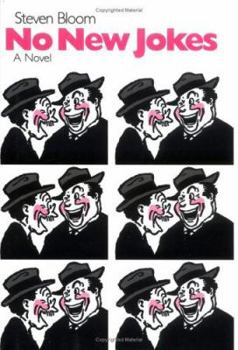
No New Jokes: A Novel

Select Format
Select Condition 
Book Overview
At Bald Sam's luncheonette in Brooklyn, Izzy and his friends Archie Feinstein, Jack Goldfarb, Benny Kubbleman, and Meyer Woolf gather to eat, to watch the Dodgers on TV, and to share their hopes and... This description may be from another edition of this product.
Format:Hardcover
Language:English
ISBN:039304047X
ISBN13:9780393040470
Release Date:January 1997
Publisher:W W Norton & Co Inc
Length:187 Pages
Weight:0.90 lbs.
Dimensions:9.0" x 0.8" x 6.0"
Customer Reviews
2 ratings
IS STEPHEN BLOOM THE ILLEGITIMATE SON OF JAMES JOYCE?
Published by Thriftbooks.com User , 25 years ago
I wrote the Kirkus Review you will find under Editorial Reviews and I direct you to that. What I failed to note in that review was the wonderful bouquet behind the author's name, Stephen Bloom, which seems to me a conflation of the two heroes of Joyce's Ulysses, Stephen Dedalus and Leopold Bloom. Since Ulysses was the artistic wellspring for the nonlinear New Wave French films of the sixties, in which editing dizzyingly rose above characterization, as in Hiroshima, Mon Amour and Last Year at Marienbad, it struck me that the same nonlinear mode of storytelling in No New Jokes, which digs into our subconscious sense of time and remembrance,was derived from Joyce and that Stephen Bloom is the pen name for some well-known writer who wants to publish something fresh without being reviewed for his earlier work rather than for this inventive new work. I'd like to know if I'm all wet about this or not, should someone know Stephen Bloom.
One of the overlooked novels of 1997. Also one of the best!
Published by Thriftbooks.com User , 28 years ago
I nearly overlooked this, the best first novel of 1997. While Stephen Bloom's "No New Jokes" was published in the first quarter of last year, I didn't become aware of it until I read a review in the "Shepherd Express", an alternative newspaper in Milwaukee WI earlier this year.To call this funny but heartbreaking short novel the best first novel of 1997 may be a disservice. I think it may rank as one of the best of the year, period. It lacks the epic sweep of Pynchon's "Mason and Dixon" and the pretensions of Delillo's great though flawed "Underworld". At 187 pages it is dwarfed by both of them in length. But it packs a wallop, nevertheless.The story centers on Izzy, forty-something WWII veteran, and the variously aged men who hang out at Bald Sam's diner in 1949 Brooklyn. They talk baseball, current events (the Bomb, Communism) and endlessly recycle the many ethnic (mostly Jewish) jokes, which have formed the fabric of their lives in the shadow of the Holocaust. Stephen Bloom gives us a good taste of post-war New York, much as Delillo does in "Underworld".Izzy is not quite right in some unexplained sense as a result of the war. He has a 90% disability pension, which he supplements by playing his concertina in the streets. But we soon learn in bits and pieces that what really haunts Izzy isn't the war but a Pogrom in 1919 back in his hometown in Poland. During this pogrom, Izzy's father is brutally murdered, so bloodied that Izzy doesn't recognize his father's corpse when he first sees it.The foregoing is undeniably grim and it is worth noting that Izzy never tells the jokes, which are peppered throughout, the novel. Nevertheless, the novel is often quite humorous. The jokes themselves are a commentary on the life struggles, both major and minor, of Izzy and his friends. The jokes point up the fact that while jokes are often told at someone's expense, they also serve to cushion life's blows.The novel ends as it opens: life (and death) goes on.
Copyright © 2026 Thriftbooks.com
Terms of Use | Privacy Policy | Do Not Sell/Share My Personal Information | Cookie Policy | Cookie Preferences | Accessibility Statement
ThriftBooks ® and the ThriftBooks ® logo are registered trademarks of Thrift Books Global, LLC
ThriftBooks ® and the ThriftBooks ® logo are registered trademarks of Thrift Books Global, LLC
