


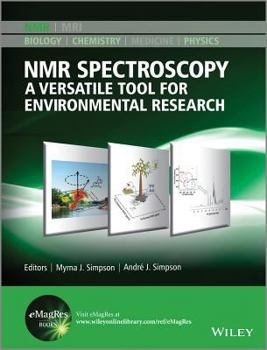
NMR Spectroscopy: A Versatile Tool for Environmental Research

The challenges faced by environmental scientists today are vast, complex, and multi-faceted. For instance, predicting the fateof an environmental pollutant or understanding ecosystem responsesto climate change, necessitate a firm understanding of molecularstructure and dynamics of environmental media as well as thecomponents that exist and interact within this media. Furthermore, linking information obtained at the molecular-scale toecosystem-level processes is a major pursuit of modernenvironmental research. As such, NMR spectroscopy and itsscalability from the molecular-scale to the macroscopic-scale, isfacilitating rapid growth in environmental science. In addition, the versatility of NMR spectroscopy has resulted in the developmentand implementation of different types of NMR techniques to examinethe structure of various types of environmental samples, living andnon-living, as well as the study of critical environmentalprocesses.
This comprehensive handbook is a collection of chapters thatspan from methods to how NMR is used in environmental research togain insight into various ecosystem properties.
It is organized into three parts:
This volume highlights the immense potential of NMR spectroscopyto expand our fundamental understanding of environmental processesand how it will continue to do so well into the future.
About eMagRes Handbooks
eMagRes (formerly the Encyclopedia of MagneticResonance) publishes a wide range of online articles on allaspects of magnetic resonance in physics, chemistry, biology andmedicine. The existence of this large number of articles, writtenby experts in various fields, is enabling the publication of aseries of eMagRes Handbooks on specific areas of NMR and MRI. Thechapters of each of these handbooks will comprise a carefullychosen selection of eMagRes articles. In consultation with theeMagRes Editorial Board, the eMagRes handbooks arecoherently planned in advance by specially-selected Editors, andnew articles are written to give appropriate complete coverage. Thehandbooks are intended to be of value and interest to researchstudents, postdoctoral fellows and other researchers learning aboutthe scientific area in question and undertaking relevantexperiments, whether in academia or industry.
Have the content of this handbook and the complete content ofeMagRes at your fingertips
Visit: www.wileyonlinelibrary.com/ref/eMagRes
Customer Reviews
ThriftBooks® and the ThriftBooks® logo are registered trademarks of Thrift Books Global, LLC
