


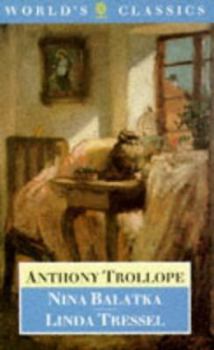
Nina Balatka and Linda Tressel


Select Format
Select Condition 
Book Overview
The heroines of these two short novels combat intense social pressure for the sake of love. The Catholic heroine of Nina Balatka loves a Jew. In Linda Tressell a stern Calvinistic matriach tries to ensure her niece's spiritual salvation by marrying her to an old man. Both novels are fascinating and sympathetic portrayals of young women driven to the brink of insanity by religious and cultural intolerance.
Format:Paperback
Language:English
ISBN:0192827235
ISBN13:9780192827234
Release Date:September 1991
Publisher:Oxford University Press, USA
Length:440 Pages
Weight:0.54 lbs.
Dimensions:0.8" x 4.6" x 7.3"
Related Subjects
Classics Contemporary Europe Fiction History Literary Literature & Fiction Russia WalesCustomer Reviews
1 rating
The Alternative Trollope
Published by Thriftbooks.com User , 25 years ago
In 1867, at a time when he was one of the best known and best selling authors in the world, Anthony Trollope conceived the idea of experimenting with anonymous publication, in order to find out whether the multitude bought his books for their literary excellence or merely for the "brand name" on the cover. Two relatively short novels, "Nina Balatka" and "Linda Tressel", were the result. Taken together, they offer a glimpse of a different Trollope from the familiar chronicler of politicians and parsons.The two stories have much in common. Each is set in a foreign city that Trollope had recently visited ("Nina" in Prague, "Linda" in Nuremberg), with a plot centered on the impact of an aunt's religious bigotry on a young woman's marital prospects. In one, the zealous aunt is Roman Catholic and opposes her niece's betrothal to a wealthy Jew. In the other, an Anabaptist aunt strives to promote a union between beautiful, wealthy Linda Tressel and a clownish, middle-aged bureaucrat."Nina" is the better realized of the two tales. Troubling the course of true love are both the antisemitism of the Balatka family and the countervailing suspicions of the Jewish community, forces that work to drive the lovers apart. Some of the machinations are clumsy, but character is, as usual, more important than incident in Trollope. The portrayal of the mutually hostile religious communities is especially effective, showing a broad range of attitudes in each camp. Nina and her fiancé are themselves complicated figures, for it takes a long time for their love to completely overcome prejudices instilled from childhood."Linda", by contrast, suffers from dramatis personae who are mostly caricatures, out of place in a serious, even grim, story. The religious motif verges on the absurd. There are reasons why a 19th century Catholic family would revolt against a relative's marriage to a Jew. There are none to move an Anabaptist to insist on linking her nearest kinswoman to a worldly boor. Indeed, the author does not have much notion of what "Anabaptists" are. (He seems to regard them as a species of Calvinist, which is about like labeling Ross Perot a "Republican".) Religious bigotry detached from any recognizable religion can evoke only laughter, which is not the response that "Linda Tressel" is supposed to arouse.Trollope's experiment did not turn out particularly well. The mildly unusual settings and themes of these works could not hide his identity from alert critics, several of whom quickly pierced the veil of anonymity. On the other hand, readers were fooled and declined to buy, even though the reviews were generally positive. "Another ten years of unpaid unflagging labor might have built up a second reputation," Trollope wrote in his autobiography, but "I could not at once induce English readers to read what I gave to them, unless I gave it with my name." That is what he did thereafter, bringing the career of the "alternative Trollope" to an end.
Copyright © 2026 Thriftbooks.com
Terms of Use | Privacy Policy | Do Not Sell/Share My Personal Information | Cookie Policy | Cookie Preferences | Accessibility Statement
ThriftBooks ® and the ThriftBooks ® logo are registered trademarks of Thrift Books Global, LLC
ThriftBooks ® and the ThriftBooks ® logo are registered trademarks of Thrift Books Global, LLC
