


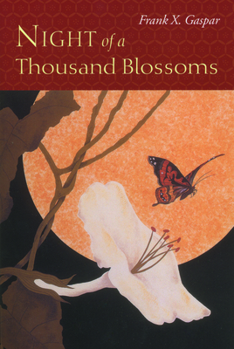
Night of a Thousand Blossoms

In these poems, the poet restlessly inhabits the night, finding it terrifying and beautiful, searching for meaning in the yard, the neighborhood, the heavens and every wise book he owns. These urban pastoral meditations employ ritual and repetition to create a kind of mantra, seeking surrender to that state of meditation leading to enlightenment-yet arguing with the idea of surrendering any attachments at all to this world we've been given to learn and love: a city garden cohabitated by ancient Romans and tattooed kids, automobiles and hollyhock, maurauding cats and the Buddha. "I should be satisfied with the household gods," he mourns, but is satisfied with nothing, determined to fit the whole world into his poems lest the one essential thing slip by.
"Frank Gaspar's poems are agile and forceful, their narratives clear and absorbing. In them, he is speaking to the reader-but also to himself, or perhaps to some hazy divinity or to the blue sky. I felt in his voice no attempt to persuade me of anything. I felt only the abiding imperative to get it right. Which is, of course, what real writing is all about."
-Mary Oliver
Customer Reviews
ThriftBooks ® and the ThriftBooks ® logo are registered trademarks of Thrift Books Global, LLC
