


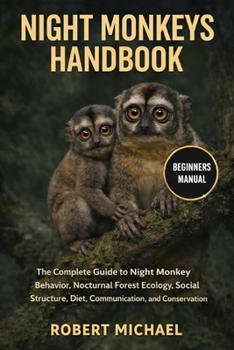
Night Monkeys Handbook: The Complete Guide to Night Monkey Behavior, Nocturnal Forest Ecology, Social Structure, Diet, Communication, and Conservation
No Customer Reviews

INTRODUCTION TO THE NIGHT MONKEY
A Primate of the Night
The night monkey, scientifically known as Aotus, occupies a rare and remarkable position among the world's primates. While most monkeys are active by day, the night monkey has evolved to live almost entirely in darkness, shaping every aspect of its biology, behavior, and perception of the world. This nocturnal lifestyle is not a simple shift in activity hours; it represents a deep evolutionary commitment that influences how the animal sees, communicates, feeds, bonds, and survives. Understanding the night monkey begins with recognizing that it experiences the forest in a fundamentally different way from diurnal primates, relying on moonlight, shadow, sound, and memory rather than bright visual cues.
Unlike many primates that display vibrant colors or expressive facial markings visible in daylight, the night monkey's appearance reflects subtlety and function. Its large, forward-facing eyes dominate its face, immediately signaling its adaptation to low-light environments. These eyes are not merely larger versions of diurnal primate eyes but are specialized tools for gathering and processing faint light, allowing the animal to move confidently through dense forest canopies long after sunset. This visual specialization alone sets the night monkey apart as an evolutionary outlier among monkeys.
Evolutionary Significance
The existence of a fully nocturnal monkey challenges common assumptions about primate evolution. Primates are often associated with daylight activity, color vision, and visually guided social behavior. The night monkey demonstrates that primates are capable of diverging dramatically from this pattern when ecological conditions favor alternative strategies. Its ancestors likely faced competitive pressures from diurnal primates, predators, or environmental constraints that made nighttime activity advantageous. Over generations, natural selection refined traits that allowed survival and success in darkness.
This evolutionary pathway resulted in a primate that balances sensitivity with caution. Night monkeys are not reckless explorers of the dark but careful, deliberate movers. Their evolutionary history has shaped a temperament that prioritizes awareness, quiet movement, and close social bonds. These traits reflect long-term adaptation rather than short-term behavioral flexibility, emphasizing that nocturnality in this species is deeply embedded rather than optional.
A Life Defined by Darkness
For the night monkey, darkness is not an obstacle but a working environment. The forest at night is cooler, quieter, and filled with different sounds and threats than the daytime forest. Insects hum, nocturnal birds call, and predators such as owls and arboreal mammals become active. The night monkey's behavior reflects an intimate familiarity with this world. Its movements are calculated, its pauses frequent, and its routes through the canopy often repeated night after night.
Living in darkness requires more than good eyesight. It demands memory, spatial awareness, and trust in known pathways. Night monkeys often rely on established routes between feeding trees, sleeping sites, and social meeting points. These mental maps reduce risk and conserve energy, reinforcing the importance of experience and learning within their social groups.
Social Identity and Pair Living
One of the most distinctive features of the night monkey is its social organization. Unlike many primates that live in large troops or multi-male groups, night monkeys typically form small family units centered on a bonded adult pair and their offspring. This structure is closely tied to their nocturnal lifestyle. Navigating the forest at night is safer and more efficient with trusted partners rather than large, noisy groups that could attract predators.
A Primate of the Night
The night monkey, scientifically known as Aotus, occupies a rare and remarkable position among the world's primates. While most monkeys are active by day, the night monkey has evolved to live almost entirely in darkness, shaping every aspect of its biology, behavior, and perception of the world. This nocturnal lifestyle is not a simple shift in activity hours; it represents a deep evolutionary commitment that influences how the animal sees, communicates, feeds, bonds, and survives. Understanding the night monkey begins with recognizing that it experiences the forest in a fundamentally different way from diurnal primates, relying on moonlight, shadow, sound, and memory rather than bright visual cues.
Unlike many primates that display vibrant colors or expressive facial markings visible in daylight, the night monkey's appearance reflects subtlety and function. Its large, forward-facing eyes dominate its face, immediately signaling its adaptation to low-light environments. These eyes are not merely larger versions of diurnal primate eyes but are specialized tools for gathering and processing faint light, allowing the animal to move confidently through dense forest canopies long after sunset. This visual specialization alone sets the night monkey apart as an evolutionary outlier among monkeys.
Evolutionary Significance
The existence of a fully nocturnal monkey challenges common assumptions about primate evolution. Primates are often associated with daylight activity, color vision, and visually guided social behavior. The night monkey demonstrates that primates are capable of diverging dramatically from this pattern when ecological conditions favor alternative strategies. Its ancestors likely faced competitive pressures from diurnal primates, predators, or environmental constraints that made nighttime activity advantageous. Over generations, natural selection refined traits that allowed survival and success in darkness.
This evolutionary pathway resulted in a primate that balances sensitivity with caution. Night monkeys are not reckless explorers of the dark but careful, deliberate movers. Their evolutionary history has shaped a temperament that prioritizes awareness, quiet movement, and close social bonds. These traits reflect long-term adaptation rather than short-term behavioral flexibility, emphasizing that nocturnality in this species is deeply embedded rather than optional.
A Life Defined by Darkness
For the night monkey, darkness is not an obstacle but a working environment. The forest at night is cooler, quieter, and filled with different sounds and threats than the daytime forest. Insects hum, nocturnal birds call, and predators such as owls and arboreal mammals become active. The night monkey's behavior reflects an intimate familiarity with this world. Its movements are calculated, its pauses frequent, and its routes through the canopy often repeated night after night.
Living in darkness requires more than good eyesight. It demands memory, spatial awareness, and trust in known pathways. Night monkeys often rely on established routes between feeding trees, sleeping sites, and social meeting points. These mental maps reduce risk and conserve energy, reinforcing the importance of experience and learning within their social groups.
Social Identity and Pair Living
One of the most distinctive features of the night monkey is its social organization. Unlike many primates that live in large troops or multi-male groups, night monkeys typically form small family units centered on a bonded adult pair and their offspring. This structure is closely tied to their nocturnal lifestyle. Navigating the forest at night is safer and more efficient with trusted partners rather than large, noisy groups that could attract predators.
Format:Paperback
Language:English
ISBN:B0GTVLH9R4
ISBN13:9798252787329
Release Date:March 2026
Publisher:Independently Published
Length:161 Pages
Weight:0.50 lbs.
Dimensions:0.3" x 6.0" x 9.0"
Related Subjects
NatureCustomer Reviews
0 rating
Copyright © 2026 Thriftbooks.com
Terms of Use | Privacy Policy | Do Not Sell/Share My Personal Information | Cookie Notice | Cookie Preferences | Accessibility Statement
ThriftBooks ® and the ThriftBooks ® logo are registered trademarks of Thrift Books Global, LLC
ThriftBooks ® and the ThriftBooks ® logo are registered trademarks of Thrift Books Global, LLC
