


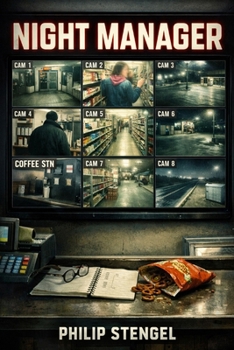
Night Manager

At 2:11 a.m. in Red Hollow, Idaho, Tiffany Cross is doing what she has done for fourteen years: running the graveyard shift at Slynker's Travel Plaza, counting cigarettes, checking coolers, eating standing up, and listening to the building breathe. Then the overnight routine fractures. A woman appears on the security feed and vanishes from the aisle where Tiffany is standing. A voice calls from the office line and tells her a man is under the restroom sink. The cameras begin showing things before they happen, after they happen, and instead of what is in front of her. What starts as a bad night at a failing gas station becomes something worse, a place that has learned how to keep people by keeping their patterns first.
As the night escalates, Slynker's reveals its true shape. The station is not simply haunted by a few dead customers or one violent event. It has become a storage system built from surveillance, repetition, drains, wiring, heat, routine, and the human traces left behind by everyone who passed through it. Tiffany faces the station's dead in forms both intimate and procedural: vanished locals, the wounded woman from the medicine aisle, familiar customers, missing townspeople, and even versions of herself and Dean, her dead husband, reconstructed through memory and recorded habit. The horror widens from one building into infrastructure when Tiffany learns the thing beneath the station can move through storm lines and into Red Hollow itself.
By the final movement, Night Manager becomes a brutal fight over containment, memory, and recurrence. Tiffany blows open the root beneath the station, destroys Slynker's, and survives the fire, but survival is only partial victory. The station's core logic escapes into the town's buried channels, reaches Birch Street, and begins learning a dead woman's house the way it learned the gas station. The ending refuses clean closure. Tiffany survives, Deputy Harlan becomes her ally, and the epilogue shifts from spectacle to vigilance as she documents taps, loops, false screens, and written intrusions in her own kitchen. This is a rural working-class horror novel about infrastructure that remembers, routine that becomes vulnerability, and the terror of realizing a place has been learning you long enough to use your life as inventory.
Customer Reviews
ThriftBooks ® and the ThriftBooks ® logo are registered trademarks of Thrift Books Global, LLC
