


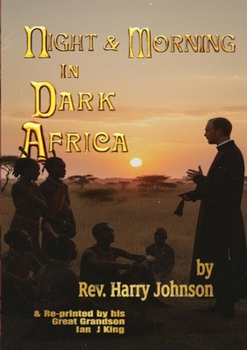
Night & Morning in Dark Africa

This memoir was written under the leadership and instructions of the London Missionary Society (LMS), and it has been out of print for more than 100 years
My great grandfather had picked up the mantle and was entrusted to follow in the very footsteps of Doctor David Livingstone himself, 20-30 years after he had died; that is within a generation.
I feel that this is a great privilege and honour to learn of, and to be a part of such a colossus history; now you can read about the work of the Gospel and how it was brought to the beautiful native people in darkest Africa.
I am thrilled to have read about some of the things my great grandfather worked tirelessly at, what he achieve with these same tribes and people that Doctor David Livingstone had also worked amongst. How could I not reprint this new edition?
This is the amazing story of the sacrifice by which my great grandfather and others, against all odds, attained. Incredible things were done amongst the people from mid-Africa, their warriors, tribes and very different cultures. I'm sure you will thoroughly enjoy such a rich history and spirited account.
Forward:
The Reverend Harry Johnson, author of Night and Morning in Dark Africa, lived an extraordinary life.
Born in December 1868 in Leicestershire, England, he was one of a family of ten, six sons and four daughters.
After studying at Cheshunt College, he was ordained in April 1896.
His strong desire to follow in the footsteps of the London Missionary Society missionary, David Livingstone, in Central Africa saw him join the LMS.
He left England in May 1896 and travelled to Africa where he joined the Tanganyika Mission of the LMS.
He initially worked at Kawimbe and then transferred to Kambole, where he established a mission station on the southern shores of Lake Tanganyika, Central Africa, in present day Zambia.
There he built a bungalow, constructed with handmade bricks, reinforced with straw and baked in the African sun. He married Minnie A. Allen, one of a family of ten children, four sons and six daughters.
in August 1897, after she had travelled out from England to Africa by herself to join him
at Zomba, near Blantyre in present day Malawi, but at that time, part of the British Central Africa Protectorate.
Their first child, Gwendolyn, was born in July 1898 and their second child, Eric, my father, was born in December 1899.
The family of four, in June 1900, travelled back to England, where their third child, Moyra, was born in August 1901, in Leicester.
In April 1902, Harry returned alone to Kambole, finally leaving the Kambole Mission Station in January 1906.
Setting off in February 1906, Harry, on behalf of the London Missionary Society, undertook a speaking tour of Australia and New Zealand.
After returning from the speaking tour he served as the Minister at the Wilsden Congregational Church in Bradford until 1912.
Leaving in early January 1913, Harry with his family travelled to Christchurch, New Zealand, arriving in mid February 1913 where he had accepted the Pastorate of the Trinity Congregational Church.
Minnie sadly died in March 1915.
Harry remarried in January 1918, Maud Allen (younger sister of Minnie) and in February 1918 he took up a new pastorate as the Minister to the Mt Eden Congregational Church in Auckland.
He moved to Wellington in 1925 where he was based at the Cambridge Terrace Congregational Church, while regularly visiting other congregations throughout the country.
Neville Johnson
Customer Reviews
ThriftBooks ® and the ThriftBooks ® logo are registered trademarks of Thrift Books Global, LLC
