


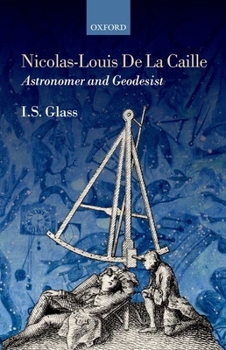
Nicolas-Louis de la Caille, Astronomer and Geodesist
No Customer Reviews

Select Format
Select Condition 
Book Overview
La Caille was one of the observational astronomers and geodesists who followed Newton in developing ideas about celestial mechanics and the shape of the earth. He provided data to the great 18th-century mathematicians involved in understanding the complex gravitational effects that the heavenly bodies have on one another. Observing from the Cape of Good Hope, he made the first ever telescopic sky survey and gave many of the southern constellations their present-day names. He measured the paths of the planets and determined their distances by trigonometry. In addition, he made a controversial measurement of the radius of the earth that seemed to prove it was pear-shaped. On a practical level, La Caille developed the method of Lunars' for determining longitudes at sea. He mapped the Cape. As an influential teacher he propagated Newton's theory of universal gravitation at a time when it was only beginning to be accepted on the European continent. This book gives the most comprehensive overview so far available of La Caille's life and work, showing how he interacted with his often difficult colleagues. It places special emphasis on his life at, and his observations and comments on, the Cape of Good Hope, where he spent the years 1751-53.
Format:Hardcover
Language:English
ISBN:019966840X
ISBN13:9780199668403
Release Date:December 2012
Publisher:Oxford University Press, Incorporated
Length:202 Pages
Weight:1.10 lbs.
Dimensions:0.8" x 6.3" x 9.2"
Customer Reviews
0 rating
Copyright © 2026 Thriftbooks.com
Terms of Use | Privacy Policy | Do Not Sell/Share My Personal Information | Cookie Notice | Cookie Preferences | Accessibility Statement
ThriftBooks ® and the ThriftBooks ® logo are registered trademarks of Thrift Books Global, LLC
ThriftBooks ® and the ThriftBooks ® logo are registered trademarks of Thrift Books Global, LLC
