


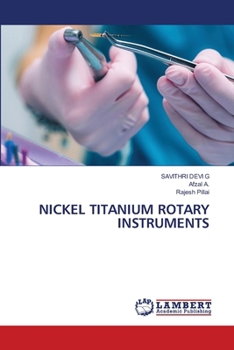
Nickel Titanium Rotary Instruments
No Customer Reviews

The NiTi alloy was developed in the United States by William Buehler in 1963 and was named NiTiNOL, an acronym for nickel (Ni), titanium (Ti), and Naval Ordnance Laboratory (NOL). In dentistry, Andreasen and Morrow initially applied the NiTiNOL in orthodontics due to its low modulus of elasticity, shape memory effect and super flexibility. The low modulus of elasticity of the NiTi alloy would allow the production of more efficient instruments to prepare curved canals.NITI alloys used in the production of endodontic instruments have almost equiatomic ratios of nickel and titanium elements and contain three microstructural phases named austenite, martensite, and R-phase. The respective amount of each one of these phases will determine the mechanical properties of the alloy. The transformation of austenite into martensite (also called classic martensitic transformation) is caused by the ability of the alloy to modify its atomic arrangement. The alteration of its crystalline microstructure and transformation characteristics directly influence the mechanical properties of the alloy.
Format:Paperback
Language:English
ISBN:6209539548
ISBN13:9786209539541
Release Date:March 2026
Publisher:LAP Lambert Academic Publishing
Length:152 Pages
Weight:0.47 lbs.
Dimensions:0.3" x 6.0" x 9.0"
Customer Reviews
0 rating
Copyright © 2026 Thriftbooks.com
Terms of Use | Privacy Policy | Do Not Sell/Share My Personal Information | Cookie Policy | Cookie Preferences | Accessibility Statement
ThriftBooks ® and the ThriftBooks ® logo are registered trademarks of Thrift Books Global, LLC
ThriftBooks ® and the ThriftBooks ® logo are registered trademarks of Thrift Books Global, LLC
