


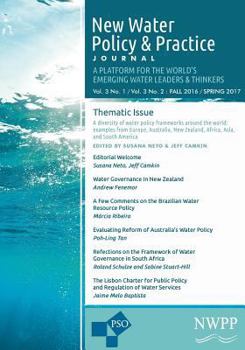
New Water Policy and Practice: Vol. 3, No. 1 & 2, Fall 2016/Spring 2017: Water Policy Frameworks from Around the World

In June 2015 the Organization for Economic Co-operation and Development (OECD) released its OECD Principles on Water Governance (OECD 2015). The Principles on Water Governance were developed on the premise that there is no one-size-fits-all, but that governance is highly contextual, that water policies need to be tailored to different water resources and places, and that governance responses have to adapt to changing circumstances. The Principles aim to "enhance water governance systems that help manage "too much", "too little", and "too polluted" water in a sustainable, integrated, and inclusive way, at an acceptable cost, and in a reasonable time-frame". In this Issue we present a journey through the lens of six existing frameworks in Europe, Asia-Pacific, Africa, and South America to understand contextual factors enhancing or constraining water governance, and made suggestions to support practical implementation of the principles through better governmental action and stakeholder involvement.
We trust that you will enjoy this introduction to some water governance frameworks around the world. We aim to continue this in future editions of New Water Policy and Practice and look forward to your contributions.
Customer Reviews
ThriftBooks ® and the ThriftBooks ® logo are registered trademarks of Thrift Books Global, LLC
