


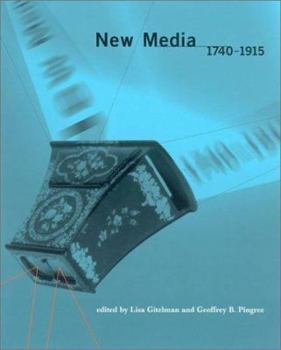
New Media, 1740-1915 (Media in Transition)

Select Format
Select Condition 
Book Overview
Reminding us that all media were once new, this book challenges the notion that tostudy new media is to study exclusively today's new media. Examining a variety of media in theirhistoric contexts, it explores those moments of transition when new media were not yet fully definedand their significance was still in flux. Examples range from familiar devices such as the telephoneand phonograph to unfamiliar curiosities such as the physiognotrace and the zograscope. Movingbeyond the story of technological innovation, the book considers emergent media as sites of ongoingcultural exchange. It considers how habits and structures of communication can frame a collectivesense of public and private and how they inform our apprehensions of the "real." By recoveringdifferent (and past) senses of media in transition, New Media, 1740-1915 promises to deepen ourhistorical understanding of all media and thus to sharpen our critical awareness of how they acquiretheir meaning and power.
Format:Hardcover
Language:English
ISBN:0262072459
ISBN13:9780262072458
Release Date:January 2003
Publisher:Mit Pr
Length:271 Pages
Weight:0.80 lbs.
Dimensions:9.5" x 1.3" x 7.8"
Customer Reviews
1 rating
Matthew Purdy in THE IOWA REVIEW says --
Published by Thriftbooks.com User , 22 years ago
"New Media, 1740-1915 traces a history of the dialogue between media and society that has continued into the present. The title alone is somewhat startling, pairing an emphatically contemporary coinage with a time frame well before the dawn of modern technology as we've come to think of it. But one of the goals of the volume is to establish a context for our own notion of new media and how its newness is constructed. . . . All of the devices in New Media, 1740-1915 were new media in their respective eras, and in a sense they are still new. They are- Gitelman and Pingree use Bruce Sterling's term- 'dead media,' media no longer used and, in many cases, long since forgotten.These devices never got the chance to become fully enmeshed in the fabric of everyday life; the telegraph and phonograph evolved, the rest faded away. As such, they appear to us today perpetually strange, embalmed in their own original novelty. The volume's central lesson, then, is not to become blinded by the promises of our own new media. Because it isn't new at all."
Copyright © 2026 Thriftbooks.com
Terms of Use | Privacy Policy | Do Not Sell/Share My Personal Information | Cookie Notice | Cookie Preferences | Accessibility Statement
ThriftBooks ® and the ThriftBooks ® logo are registered trademarks of Thrift Books Global, LLC
ThriftBooks ® and the ThriftBooks ® logo are registered trademarks of Thrift Books Global, LLC
