


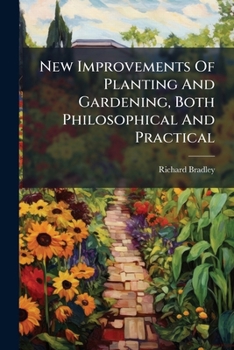
New Improvements Of Planting And Gardening, Both Philosophical And Practical: In Three Parts. I. Containing, A New System Of Vegetation ... Ii. The Be

Select Format
Select Condition 
Book Overview
"New Improvements Of Planting And Gardening, Both Philosophical And Practical" by Richard Bradley, originally published in the 18th century, offers a fascinating glimpse into the horticultural practices and botanical understanding of the time. This comprehensive guide, divided into three parts, explores a new system of vegetation, providing insights into the scientific principles underpinning plant growth and cultivation. The second part delves into the art of creating and improving flower gardens and parterres, offering detailed instructions and design considerations. Finally, the book addresses the cultivation and improvement of fruit trees, sharing techniques for enhancing fruit production and quality.
Bradley's work reflects the philosophical and practical approaches to gardening during the Enlightenment, blending scientific inquiry with hands-on advice. This historical text is a valuable resource for anyone interested in the history of gardening, botany, and agricultural science, providing a unique perspective on the evolution of horticultural techniques and the enduring relationship between humans and the natural world.
This work has been selected by scholars as being culturally important, and is part of the knowledge base of civilization as we know it. This work was reproduced from the original artifact, and remains as true to the original work as possible. Therefore, you will see the original copyright references, library stamps (as most of these works have been housed in our most important libraries around the world), and other notations in the work.
This work is in the public domain in the United States of America, and possibly other nations. Within the United States, you may freely copy and distribute this work, as no entity (individual or corporate) has a copyright on the body of the work.
As a reproduction of a historical artifact, this work may contain missing or blurred pages, poor pictures, errant marks, etc. Scholars believe, and we concur, that this work is important enough to be preserved, reproduced, and made generally available to the public. We appreciate your support of the preservation process, and thank you for being an important part of keeping this knowledge alive and relevant.
Customer Reviews
ThriftBooks® and the ThriftBooks® logo are registered trademarks of Thrift Books Global, LLC
