


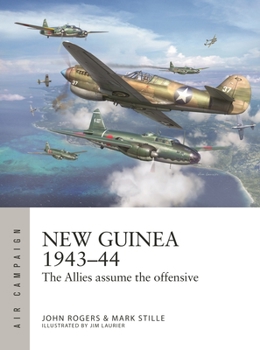
New Guinea 1943-44: The Allies Assume the Offensive
No Customer Reviews

Fully illustrated, this is a history of airpower in the decisive stage of the New Guinea campaign, when the Allies could finally go on the offensive to shatter Japanese forces.
In mid-1943, the Imperial Japanese Army Air Force (IJAAF) took over responsibility for New Guinea air operations from the Imperial Japanese Navy. In its first large-scale contest against the USAAF, the IJAAF was challenged to defend its bases, defend the sea lanes supporting numerous Japanese outposts along the coast, and influence ground operations. In this book, the second of two on the New Guinea campaign, Pacific War scholars Mark Stille and John Rogers draw upon years of research and Japanese, American and Australian sources to explain how the New Guinea air war turned against the Japanese between June 1943 and 1944. The over-extended IJAAF gradually lost combat strength in the face of vastly improved Allied airpower, leaving the Japanese unable to contend. One prong of the Allies' air offensive targeted Japanese shipping to isolate its forces, while the other supported the ground offensives and landings that smashed Japanese forces and left most of them isolated for the rest of the war. Packed with artwork, maps, and archive photos, this book explains how the lessons learned and the forces built up during the harsh struggle for Papua in 1942-43 transformed the Allies' airpower into a decisive element in MacArthur's 1943-44 campaign.Format:Paperback
Language:English
ISBN:1472870352
ISBN13:9781472870353
Release Date:August 2026
Publisher:Osprey Publishing (UK)
Length:96 Pages
Weight:1.00 lbs.
Dimensions:1.0" x 7.2" x 9.8"
Customer Reviews
0 rating
Copyright © 2026 Thriftbooks.com Terms of Use
| Privacy Policy | Do Not
Sell/Share My Personal Information | Cookie Policy | Cookie Preferences | Accessibility Statement
ThriftBooks® and the ThriftBooks® logo are registered trademarks of Thrift Books Global, LLC
ThriftBooks® and the ThriftBooks® logo are registered trademarks of Thrift Books Global, LLC
