


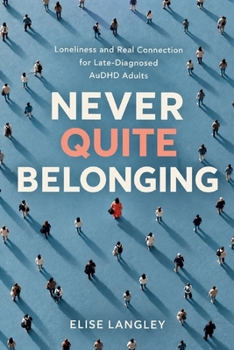
Never Quite Belonging: Loneliness and Real Connection for Late-Diagnosed AuDHD Adults

You can have friends, a family, a job and a full social life - and still wonder why you never quite feel like you belong.
For many late-diagnosed AuDHD adults, loneliness doesn't look like being alone.
It looks like sitting in a room full of people while quietly monitoring every word you say. Replaying conversations afterwards. Hiding the intensity. Getting the eye contact right. Laughing at the right moment. Making yourself easier to understand.
And then going home exhausted, wondering why connection seems to come so naturally to everyone else.
Never Quite Belonging explores the particular kind of loneliness that can come with being autistic and ADHD in a world that often expects you to communicate, socialise and connect differently.
Written especially for late-diagnosed and self-recognising AuDHD adults, this compassionate guide puts words to experiences you may have carried for decades without knowing how to explain them.
Inside, you'll explore:
- Why you can feel lonely even when you're surrounded by people
- How years of masking can leave you feeling unseen - and disconnected from yourself
- Why being liked isn't always the same as feeling truly known
- The exhaustion behind constantly monitoring and translating yourself
- The grief that can follow a late autism, ADHD or AuDHD recognition
- Why advice like "just put yourself out there" can leave you feeling even more depleted
- How to recognise connection that actually fits your nervous system and social energy
- Why depth, shared interests and smaller connections may matter more than a large social circle
- How to begin letting yourself be known without feeling completely exposed
- The difference between restorative solitude and isolation that is beginning to hurt
- How to reconnect with the person underneath years of adapting, accommodating and performing
This isn't a book about teaching you how to work a room, make more small talk or become a more socially acceptable version of yourself.
It's about understanding why belonging has sometimes felt so difficult in the first place - and building a different kind of connection from here.
You don't need to become better at pretending to fit.
You need relationships and spaces where you don't have to work so hard to belong.
If you've spent years feeling like everyone else knew something about being human that you somehow missed, Never Quite Belonging was written for you.
Customer Reviews
ThriftBooks ® and the ThriftBooks ® logo are registered trademarks of Thrift Books Global, LLC
