


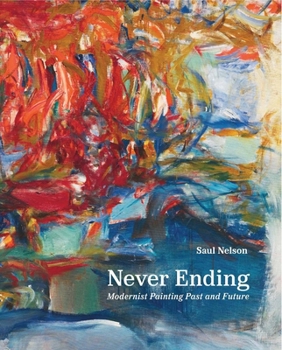
Never Ending: Modernist Painting Past and Future
No Customer Reviews

A new history of postwar painting that explores how the desire to look backward shaped some of the period's most radical artmaking This incisive account of modernism's postwar development examines how painters, such as Joan Mitchell, Barnett Newman, and Rose Piper, invoked tradition in order to respond to, participate in, and disrupt the histories of the movement being written at midcentury. Saul Nelson argues that artists' turn to the past, often dismissed as regressive, offers an important counternarrative to the notion of modernism as always pushing forward. To be a modernist, Nelson contends, was to live in doubt--about which aspects of the past were still needed and how they might be put to new use. The story ranges across continents and historical boundaries, from India to Europe and the United States. It encompasses Grace Hartigan's and Mitchell's feminist reworkings of Matisse, the links between the work of Newman and nationalistic nineteenth-century painting, the attempts of Piper to salvage a heritage from the Harlem Renaissance, and F. N. Souza's interrogations of the legacies of colonialism. Never Ending presents a new history of postwar painting in which modernism is reimagined as a practice of retrieval and reinvention, a ceaseless confrontation between tradition and the demands of the present.
Format:Hardcover
Language:English
ISBN:0300272308
ISBN13:9780300272307
Release Date:April 2024
Publisher:Yale University Press
Length:224 Pages
Weight:2.70 lbs.
Dimensions:1.1" x 7.3" x 10.2"
Customer Reviews
0 rating
Copyright © 2026 Thriftbooks.com
Terms of Use | Privacy Policy | Do Not Sell/Share My Personal Information | Cookie Policy | Cookie Preferences | Accessibility Statement
ThriftBooks ® and the ThriftBooks ® logo are registered trademarks of Thrift Books Global, LLC
ThriftBooks ® and the ThriftBooks ® logo are registered trademarks of Thrift Books Global, LLC
