


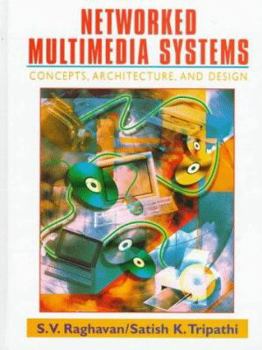
Networked Multimedia Systems


Integrates multimedia and networking concepts to teach the key technologies in designing multimedia systems. Students learn how to simultaneously access and display audio, video and graphics in both... This description may be from another edition of this product.
Format:Hardcover
Language:English
ISBN:0132106426
ISBN13:9780132106429
Release Date:January 1998
Publisher:Prentice Hall
Length:397 Pages
Weight:1.75 lbs.
Dimensions:9.8" x 0.8" x 7.0"
Customer Reviews
2 ratings
Still has some value in system analysis issues
Published by Thriftbooks.com User , 19 years ago
This book was probably about 4.5 stars when it was first published. Add nine years, and it loses another half star. However, it is not as bad as people make it out to be, and it is so generic in parts that the vast majority of chapters haven't lost a step since its pubication date. A better title for this book might have been "Networked Multimedia Systems Analysis and Design", because that is what it spends the vast majority of pages doing. The parts that have lost the most value are the sections that try to describe anything related to current network technology as it was circa 1998 such as most of chapter 5 in which ATM is seen as "the wave of the future", and much time is spent explaining the intricacies of FDDI. Fast Ethernet came along just as ATM was starting to happen, and although it didn't have the performance guarantees of ATM, nobody really cared because when you've got 100Mbit/sec of bandwidth, there's usually plenty to spare. You could generally say the same thing about chapter four on I/O and devices. Most of the storage technologies they mention are still around, they just make one great big omission - DVD. What saves that chapter is that it is more about calculations involved for I/O devices to insure that your system's I/O devices are fast enough and that you have sufficient capacity - they simply use the numbers for old devices. However, the TYPES of calculations are the same, it's just that the capacity and speed on the newer devices is much higher. Continuing to go backwards through the book, the first three chapters are still pretty much valid because the object of discussion is just the basics of multimedia, considerations when building a multimedia system, and coding and compression issues. Sure, JPEG-2000 has come along since this book was published, but other than that the first three chapters are valid. Where this textbook really shines is in chapters 6 through 12, which is the rest of the book. Here the issue is analysis of multimedia systems using various numerical techniques to insure that you have sufficient capacity in the areas of traffic, buffering, traffic shaping, scheduling and congestion control. There are numerous numerical examples given, and I know I never had any trouble solving the homework assignments based on the book's contents - it was clear and detailed enough that it did the job. Our professor was a very poor instructor and his slides basically just copied the pages from the book, so I do remember the book had to stand alone as a source of knowledge in my Multimedia Systems class. I've looked at more modern textbooks that tackle these issues, but they're just not as clear and detailed as this one is. Thus, if you are looking for a book that talks about the components of a modern multimedia system, then you have the wrong book. If you are looking for the mathematical techniques of insuring that your networked multimedia system is sufficient plus some basic information on multimedia systems and c
It is a GREAT book
Published by Thriftbooks.com User , 26 years ago
I found the topics to be very technically challenging. It is also lucidly written and sure worth its value. The references are also great for me, as I am a doctoral candidate in Networks.
Copyright © 2026 Thriftbooks.com Terms of Use
| Privacy Policy | Do Not
Sell/Share My Personal Information | Cookie Policy | Cookie Preferences | Accessibility Statement
ThriftBooks® and the ThriftBooks® logo are registered trademarks of Thrift Books Global, LLC
ThriftBooks® and the ThriftBooks® logo are registered trademarks of Thrift Books Global, LLC
