


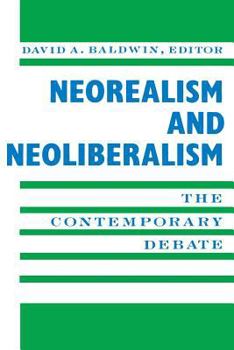
Neorealism and Neoliberalism: The Contemporary Debate

Select Format
Select Condition 
Book Overview
Essays by prominent political theorists representing the two dominant schools of international relations, neoliberalism and neorealism.
Format:Paperback
Language:English
ISBN:0231084412
ISBN13:9780231084413
Release Date:April 1993
Publisher:Columbia University Press
Length:375 Pages
Weight:1.22 lbs.
Dimensions:0.8" x 6.0" x 8.9"
Age Range:22 years and up
Grade Range:Postsecondary and higher
Customer Reviews
1 rating
The Problem of Cooperation in International Politics
Published by Thriftbooks.com User , 23 years ago
David A. Baldwin's edited work of Neorealism and Neoliberalism is composed of twelve chapters. Arthur Stein remarks that states take decisions independently in anarchic international system while institutions/regimes necessitate joint decision making in this process. Stein cited regimes as a solution to common cooperation problems in the prisoners' dilemma settings. He also argues that regimes create an environment, in which states find rational incentives for cooperation since rational self-interest would lead to joint decision making through regimes. It is also remarkable in Stein's chapter that he holds power as determinant of regime transformation, however, he also ties changes in knowledge and technology as important sources of regime change. Charles Lipson in "International Cooperation in Economic and Security Affairs" basically points out that international cooperation in economic areas is relatively more easier than in security issues since relative gains calculations are dominant in security-military realm while absolute gain assumptions are more likely to happen in economic affairs. On the other hand, Lipson also argues that neorealism generally ignores the role of interdependence in international cooperation. In fact, this tendency is one the fundamental differences between neorealists and neoliberals. While the former generally assumes that interdependency lead to conflict among states the latter sees it much more as facilitating factor for international cooperation. Robert Axelrod and Robert D. Keohane's "Achieving Cooperation under Anarchy: Strategies and Institutions" has important insights about the problem of cooperation. They mention three factors that directly influence the probability of cooperation among states. They are mutuality of interests (payoff structure), the shadow of future, and the number of players (sanction problem). These considerations, no doubt, are about game theory driven settings among states. In addition, they emphasize that states should not be considered under just one game setting; rather multilevel games in various issue areas take place among states. Duncan Snidal also emphasizes the difference between two-state and multi-state settings in the seventh chapter. Moreover, Axelrod and Keohane attribute significant importance to perceptions and misperceptions for international cooperation. In the following chapter, Joseph M. Grieco makes a critique of neoliberal institutionalism (NLI). He generally sees NLI as unsuccessful in their criticisms of realism. However, he separates sociological institutionalists and knowledge driven institutionalists from NLI as well competitors with realist approach of institutions and international cooperation in general.There are two important arguments that deserve attention in Helen Milner's chapter. First of them, the separation of domestic and international politics is not so useful in studying the problem of international cooperation since sharp distinctions are hardly
Copyright © 2026 Thriftbooks.com Terms of Use
| Privacy Policy | Do Not
Sell/Share My Personal Information | Cookie Policy | Cookie Preferences | Accessibility Statement
ThriftBooks® and the ThriftBooks® logo are registered trademarks of Thrift Books Global, LLC
ThriftBooks® and the ThriftBooks® logo are registered trademarks of Thrift Books Global, LLC
