


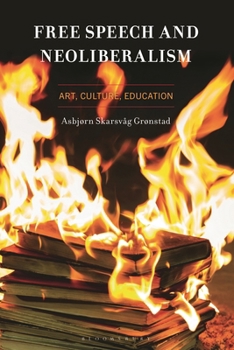
Free Speech and Neoliberalism: Art, Culture, Education
No Customer Reviews

In this book, Asbj rn Skarsv g Gr nstad challenges us to reconceptualize the notion of free speech. Focusing on the domains of cultural production, aesthetics, and education, Gr nstad contends that neoliberalism currently poses the greatest threat to our freedom of expression.
Crucially, the book argues that freedom of speech should no longer be considered merely as parrhesia-understood as the license to offend-but also as isegoria, the equal right to speak. The latter denotes the original meaning of free speech, Gr nstad posits, and should be restored as the conceptual ambit of the term, despite being largely overlooked after Greek Antiquity. Gr nstad examines a variety of texts across formats including Fahrenheit 451, Alphaville (1965), Severance, the performance art of Jingyi Wang, and the films of Yorgos Lanthimos to conduct a multi-faceted engagement with cultural works and discourses spanning both genre and historical period that grapple with issues of free speech, censorship, and neoliberal politics. Ultimately, these analyses highlight how art and aesthetics represent a particular case of isegoria, and more broadly, how neoliberal rationality operates to delimit the space of the sayable and the expressible.Format:Hardcover
Language:English
ISBN:B0F7H2VDDY
ISBN13:9798765167823
Release Date:May 2026
Publisher:Bloomsbury Academic
Length:248 Pages
Weight:1.11 lbs.
Dimensions:1.1" x 1.1" x 1.1"
Customer Reviews
0 rating
Copyright © 2026 Thriftbooks.com Terms of Use
| Privacy Policy | Do Not
Sell/Share My Personal Information | Cookie Policy | Cookie Preferences | Accessibility Statement
ThriftBooks® and the ThriftBooks® logo are registered trademarks of Thrift Books Global, LLC
ThriftBooks® and the ThriftBooks® logo are registered trademarks of Thrift Books Global, LLC
