


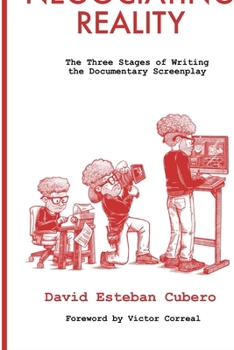
Negotiating Reality: The Three Stages of Writing the Documentary Screenplay (screenwriter's library)

This book is much more than a handbook. It is an invitation to film, to write from reality and, as in my case, to reconnect with that unique vertigo that only documentary cinema can give you. (V ctor Correal)
Negotiate with reality and write your documentary three times: before, during, and after the shoot.
How do you plan without suffocating the unpredictable?
What is a "world hypothesis," and how do you formulate one?
How do you rewrite during production without losing your way?
How does editing discover the story's final meaning?
This book is a practical compass for documentary screenwriters: it explores the constant negotiation between what is planned and what is unforeseen, presents the three-writing framework (pre-production, shooting, and editing), and offers concrete tools-from premise to final cut-to turn uncertainty into narrative, ethical, and production decisions.
Apply the three writings: a preliminary hypothesis, rewriting during shooting, and meaning-making in editing.
Design the premise and theme, structure, step outline, and treatment before filming.
Distinguish between closed vs. open scripts, observational vs. argumentative approaches to choose your focus.
Prepare the location script, documentary casting, and the temporal dimension as pillars of pre-production writing.
Anticipate the unpredictable: adjust expectations and maintain narrative flexibility.
Integrate budget and feasibility into dramaturgy.
Master shooting as a rewriting process: guiding questions, the director's presence, and camera/sound as narrators.
Work on the final rewrite in editing as the definitive script.
As far back as I can remember, screenwriting and documentary have eyed each other sideways, like two siblings who share a room but never quite fit together. It always threw me off to sit through the end credits of one of those festival gems and realize that, so often... there was no screenwriter's name. "It must be the director," I'd think-though, truth be told, it always grated on me that the work stayed in the shadows. Over time I understood that, on the terrain of the real, the script moves, slips away, and takes on new shapes at every step.
This book was born with the ambition of being a compass rather than a map. It doesn't aim to dictate a single route, but to offer you questions, tricks, and shortcuts so you can feel the pulse of writing in three different settings: the note-covered table, the shoot beating in the present tense, and the editing room where everything begins again. I've decided to focus on the "how" of building a documentary-what tools, what decisions, what unexpected turns-and leave the "what to tell" for another conversation, perhaps over coffee or in the pages of another book.
The authorDavid Esteban Cubero is the screenwriter of box-office hits such as Explota explota and television programs such as Caiga Quien Caiga, Saturday Night Live, and El Gran Juego de la Oca. He has become one of the leading Spanish-language references for screenwriting education thanks to the podcast Guiones y guionistas, with more than 1 million listens; the platform cursosdeguion.com, an online academy for hundreds of aspiring professional screenwriters; and the books From MacGuffin to Cliffhanger: 25 Narrative Tools from the Screenwriter's Toolkit and Writing Fear: Screenwriting in Horror Cinema.
Customer Reviews
ThriftBooks ® and the ThriftBooks ® logo are registered trademarks of Thrift Books Global, LLC
