


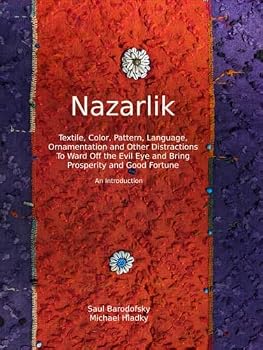
Nazarlik: Textile, Color, Pattern, Language, Ornamentation and Other Distractions To Ward Off the Evil Eye and Bring Prosperity and Good Fortune: An Introduction
No Customer Reviews

Such a fascinating book! The material is captivating and contributes much to the visual language of these cultures. Dennis Dodds, Ddds, Secretary General, International Conference on Oriental Rugs (I.C.O.C.) Two specialists in the field of tribal and nomadic textiles - Saul Barodofsky and Michael Hladky - share their expertise in this intensely visual introduction to "nazarlik," charms and talismans that ward off evil. The book covers a huge range of nazarlik styles (woven to metallic), types (rugs to spoons) and regions (Turkey to India). Stunningly beautiful, the work offers a short and accessible overview to the topic with its well curated chapters. Lovely on a coffee table, but wouldn't be out of place in a scholar's bookcase. Dr. Adam Geiser, Middle East Center, Florida State University The historical fear of the unseen led to the widespread belief in the "evil eye," a curse transmitted through a malevolent glare. Protective amulets against this perceived threat date back 5,000 years. "Nazarlik," derived from the Arabic word for "see," refers specifically to objects intended to ward off such ill will. While belief in the evil eye exists globally, it holds particular significance in Eastern cultures, notably in Turkish folklore and Islamic tradition, spanning various historical eras and cultural boundaries. Even today, Nazarlik symbols, like the familiar blue bead, remain prevalent, used for protection on clothing, in homes, cars, and even as modern fashion statements. Drawing on over 50 years of experience with textiles from Turkey and Asia, the authors highlight the Nazarlik's powerful influence on cultural designs, especially within the weavings of tribal peoples along the Silk Road. Colors, symbols, and shapes incorporated into textiles often reflect deep-seated protective beliefs. The author explains that the term 'Nazarlik' is used broadly for apotropaic objects along the Silk Road, and the related study aims not to be exhaustive but to connect traditional textile symbols with their cultural meanings, exploring aspects like color, shape, and pattern used to deflect misfortune and attract good fortune, serving as a guide to understanding and collecting these significant textiles and objects.
Format:Hardcover
Language:English
ISBN:B0F628932Z
ISBN13:9798334208780
Release Date:April 2025
Publisher:Independently published
Length:171 Pages
Dimensions:11.0" x 0.6" x 8.3"
Customer Reviews
0 rating
Copyright © 2026 Thriftbooks.com
Terms of Use | Privacy Policy | Do Not Sell/Share My Personal Information | Cookie Notice | Cookie Preferences | Accessibility Statement
ThriftBooks ® and the ThriftBooks ® logo are registered trademarks of Thrift Books Global, LLC
ThriftBooks ® and the ThriftBooks ® logo are registered trademarks of Thrift Books Global, LLC
